
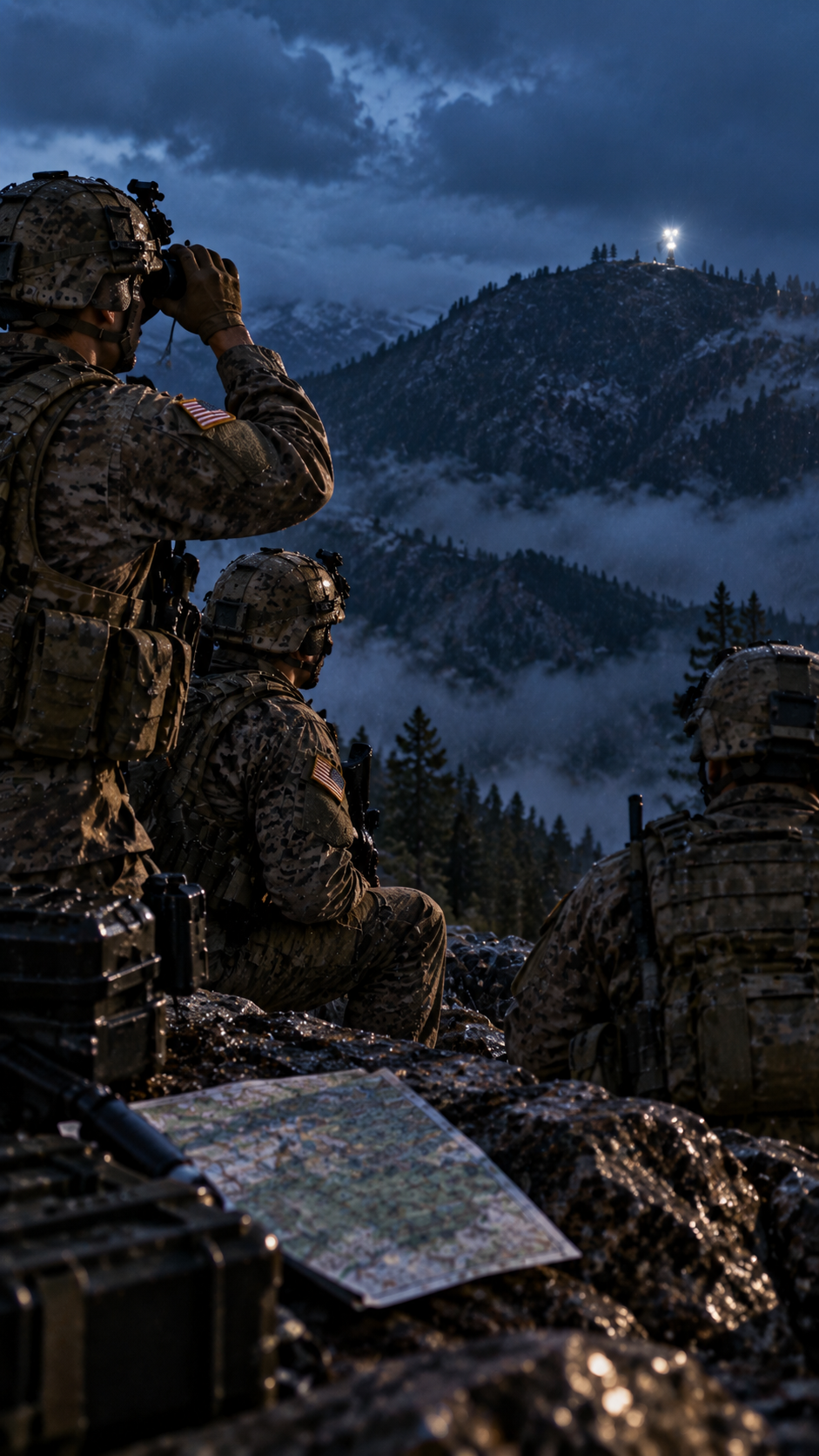
PART 2: THE MAN BEHIND THE LIGHT
Captain Reed studied Ryan’s face.
“What does ‘don’t approach from below’ mean?”
Ryan unfolded the terrain map across the hood of a vehicle.
Two nights earlier, Sergeant Daniel Mercer—the leader of the missing patrol—had joked about what they would do if every piece of electronic equipment failed.
Mercer had pointed at his small backup flashlight.
“Three flashes means somebody’s here.”
Then he had demonstrated another sequence.
Three.
Two.
One long beam.
“And that means don’t use the obvious approach.”
At the time, Ryan had laughed.
Now nobody was laughing.
Instead of sending the search team directly up the lower trail, Reed ordered them to hold while the ridge was checked from a safer angle.
As dawn slowly revealed the mountain, the reason became clear.
The overnight storm had changed the terrain.
A section of the lower slope had partially collapsed. Mud, loose rock and fallen trees covered the route that appeared safest on the map.
Ryan looked toward the ridge.
The flashlight flashed again.
Three times.
“We see you,” Ryan whispered.
The search team moved along higher, firmer ground, maintaining visual contact with the light whenever the fog opened.
Nearly an hour later, Ryan heard someone shout.
“Movement ahead!”
Four figures appeared between the trees.
Sergeant Daniel Mercer was supporting one of his soldiers by the shoulder. Another carried damaged communications equipment.
All four were exhausted.
All four were alive.
Ryan reached Mercer first.
“You’ve been flashing that light for hours?”
Mercer gave a tired smile.
“Since about two.”
“What happened?”
Mercer explained that the storm had damaged their radio equipment while the terrain blocked reliable positioning signals.
They had attempted to return by their original route but discovered the lower slope had become unstable.
So Mercer moved the patrol toward higher ground.
One soldier had injured his ankle during the climb, slowing them considerably.
They reached the ridge before dawn.
From there, Mercer could see faint lights from the temporary command post far below.
His radio was useless.
His locator wasn’t dependable.
But the cheapest piece of equipment in his pocket still worked.
A flashlight.
“So you kept signaling?”
Mercer nodded.
“Didn’t know if anyone could see it.”
Ryan looked at him.
“I almost thought it was a reflection.”
Mercer laughed quietly.
“Would’ve been one stubborn reflection.”
Later that morning, after all four soldiers had been evaluated and accounted for, Ryan placed Mercer’s scratched flashlight on the command table.
Around it sat radios, navigation equipment and other sophisticated gear.
Captain Reed looked at the tiny flashlight.
“Funny.”
Ryan glanced at him.
“What?”
“We spend all this time thinking about what happens when technology works.”
Reed tapped the flashlight gently.
“Sometimes we should spend more time thinking about what happens when it doesn’t.”
The incident changed how their unit prepared for communication failures.
Not because flashlights suddenly became more important than radios.
But because everyone understood the larger lesson.
A backup plan only matters if it is simple enough to survive when everything complicated stops working.
Weeks later, Ryan saw Mercer attaching the same battered flashlight to his gear.
“You’re still carrying that thing?”
Mercer smiled.
Ryan already knew the answer.
“Especially that thing.”