
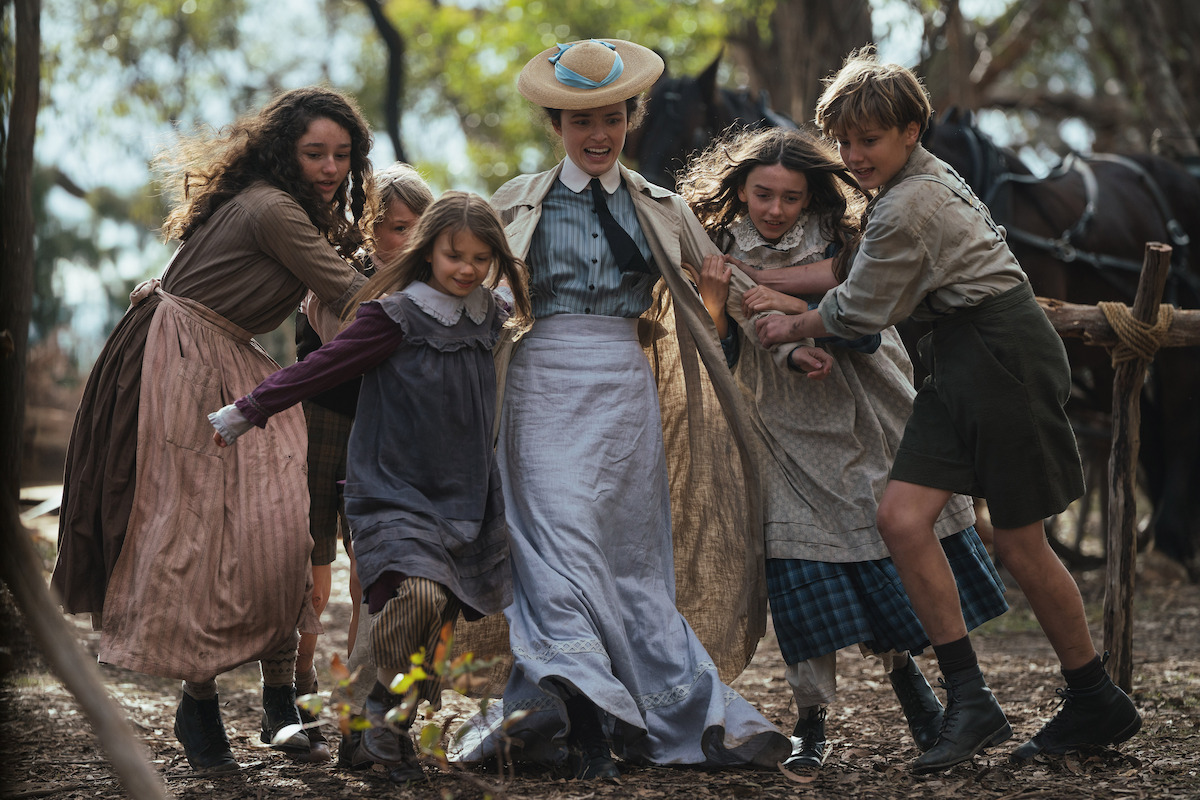
Beautiful estates. Sweeping Australian landscapes. Elegant dresses. Family expectations. A wealthy young man who seems to offer everything a woman of her generation could reasonably want.
It sounds like the perfect setup for another sweeping period romance.
Except the heroine has absolutely no intention of behaving like one.
At the center of Netflix’s latest six-part historical drama is a young woman who is restless, sharp-tongued, ambitious, and painfully aware that the world around her has already decided what her life should look like.
She is expected to become respectable.
She is expected to find a husband.
And above all, she is expected to stop imagining that she might become something more.
Her response is simple.
No.
She wants to write.
And she is willing to risk love, security, family approval, and perhaps even happiness itself for the chance to build a life that belongs entirely to her.
A Heroine Who Feels Strangely Modern
The story takes place in Australia around the beginning of the 20th century, but its central conflict feels surprisingly contemporary.
Sybylla Melvyn comes from a struggling rural family and possesses one overwhelming ambition: she wants to become a writer.
Her family has rather different plans.
With money scarce and Sybylla showing little interest in becoming the obedient daughter everyone expects, she is sent away to stay with her wealthy grandmother.
There, surrounded by privilege and high society, she is supposed to be polished into a suitable young woman and eventually find an appropriate husband.
Instead, Sybylla treats social convention almost like an opponent she has been waiting to fight.
She speaks when she is expected to remain quiet.
She questions rules everyone else accepts.
She behaves with an irreverence that can be funny one moment and deeply uncomfortable the next.
And beneath all of it is the conviction that marriage cannot be the only meaningful destination available to a woman.
That becomes increasingly difficult to maintain when romance enters the picture.
Then Harry Appears
Harry Beecham represents almost everything Sybylla is supposed to want.
He is charming, wealthy, intelligent, and drawn to precisely the qualities that make other people consider her difficult.
Instead of demanding that Sybylla become quieter or more conventional, he is fascinated by her.
Their connection creates the central tension of the series.
Because Sybylla is not rejecting love.
That would make her decision much easier.
She is confronting something far more complicated: the possibility that she may genuinely love someone and still refuse the life that love appears to require.
Christopher Chung plays Harry opposite Philippa Northeast’s Sybylla, creating a relationship built as much on intellectual attraction and conflict as conventional romance.
The more their feelings develop, the less straightforward Sybylla’s belief in independence becomes.
Suddenly the choice is not freedom versus an obviously terrible marriage.
It is freedom versus a man she might actually want.
And that is exactly what makes the story hurt.
The Real Battle Is Over Who Gets to Write Her Life
Sybylla’s desire to become an author is not simply a career ambition.
It is the foundation of her identity.
Writing represents financial independence, creative freedom, and the possibility of escaping the narrow future that society has prepared for her.
Marriage, by contrast, threatens to absorb her into someone else’s story.
That fear follows her through the series.
Family members attempt to shape her.
Society judges her.
Romance complicates her certainty.
Even poverty threatens to make independence feel like a luxury she cannot afford.
Yet Sybylla continues to insist on something radical for a woman living in 1900:
Her life belongs to her.
Netflix describes her as a woman determined to “write her own story” in an era that expects her to marry and settle down, and that conflict drives all six episodes.
The Gorgeous Setting Hides a Much Messier World
Visually, the series delivers exactly what period-drama audiences expect.
Historic homes, vineyards, sprawling countryside, horses, elaborate interiors, formal dinners, romantic landscapes — the production makes extensive use of South Australia to create its turn-of-the-century world.
But the beauty is deliberately deceptive.
Behind it sit class divisions, sexism, financial desperation, racism, and the limited choices available to women.
The new adaptation also expands the world beyond the romantic and social concerns traditionally associated with Sybylla’s story.
Sherry-Lee Watson plays Nell, a First Nations horse trainer whose experiences allow the series to examine parts of Australian history largely absent from older versions of the story.
Netflix says First Nations creatives were involved across script development, casting, design, and production in an effort to broaden how the period is represented.
That gives this adaptation a different perspective from simply reproducing an Edwardian romance with modern production values.
It wants the world around Sybylla to feel beautiful.
But it does not want viewers to mistake beauty for fairness.
So What Is the Series?
The drama is My Brilliant Career, Netflix’s new six-part adaptation of Miles Franklin’s landmark 1901 Australian novel.
Philippa Northeast leads the cast as Sybylla Melvyn, with Christopher Chung as Harry Beecham.
The ensemble also includes Genevieve O’Reilly as Helen, Anna Chancellor as the formidable Mrs. Bossier, Kate Mulvany as Augusta, Jake Dunn as Frank, Alexander England as Julius, Sherry-Lee Watson as Nell, and Miah Madden as Betty.
Liz Doran developed the adaptation and serves as writer and executive producer, while Alyssa McClelland directs Episodes 1–3 and Anne Renton directs Episodes 4–6.
All six episodes arrived globally on Netflix on August 13, 2026.
And although some may describe it as a reboot, it is more accurately a fresh television adaptation of Franklin’s novel rather than a remake of the famous 1979 movie.
A Story That Has Already Survived More Than a Century
Miles Franklin published My Brilliant Career in 1901, when she was still remarkably young herself.
Its heroine immediately stood out.
Sybylla was opinionated, contradictory, ambitious, romantic, angry, funny, and unwilling to accept the idea that marriage should automatically represent a woman’s happy ending.
The book later inspired the acclaimed 1979 film starring Judy Davis as Sybylla and Sam Neill as Harry.
That adaptation became one of the defining Australian films of its era and helped introduce both actors to international audiences.
Netflix’s version therefore faces an unusual challenge.
It must tell a story that is more than 120 years old, following a movie adaptation already considered a classic, while convincing modern viewers that Sybylla still has something to say.
The answer appears to be leaning into exactly how contemporary she already was.
She does not need to be transformed into a modern feminist character.
Miles Franklin created one in 1901.
The Series Makes Some Significant Changes
This is not a museum-piece adaptation.
The six-episode format gives the writers considerably more room than a feature film, allowing supporting characters and social issues to receive larger storylines.
The production also introduces contemporary energy into its presentation, including stylistic choices and a deliberately lively tone rather than treating the source material with excessive reverence.
Critics have particularly noted the show’s energetic approach to period drama and its willingness to expand the social world surrounding Sybylla.
The Financial Times described the adaptation as a lively six-part drama with particular strength in Sybylla’s resistance to conventional expectations, while Rotten Tomatoes currently lists the series with a 100% critics’ score from 24 reviews, though audience reception is notably more divided.
That split makes sense.
This version is not attempting to disappear quietly into the tradition of prestigious literary adaptations.
It has personality.
And Sybylla herself would probably consider anything less a failure.
But Romance Remains the Trap at the Center of Everything
For all its themes of independence, class, creativity, and social change, the most emotionally difficult question remains Harry.
Sybylla can rebel against relatives.
She can laugh at social etiquette.
She can rage against poverty.
She can insist that she will become a writer.
Harry is harder.
Because choosing him would not necessarily make her miserable.
That is the point.
Sometimes the most dangerous compromise is not choosing something terrible.
It is choosing something wonderful that may quietly require abandoning another part of yourself.
Sybylla has to decide whether love can exist without surrender.
Whether marriage can coexist with ambition.
And whether walking away from someone you love can sometimes be an act of self-preservation rather than tragedy.
Those questions gave Miles Franklin’s novel its power in 1901.
More than a century later, they have not entirely disappeared.
The Title Finally Makes Sense
At first, My Brilliant Career sounds almost boastful.
By the end, it becomes something closer to a declaration.
Sybylla does not know whether she will become successful.
She does not know whether her writing will make her famous.
She cannot even know whether choosing independence will ultimately make her happy.
What she knows is that she wants the right to try.
That distinction is what makes this more than another beautifully dressed romance.
The story is not asking whether Sybylla will find the right man.
It is asking whether she will be permitted to become the person she believes she can be.
And when love finally forces her to choose between the life waiting for her and the uncertain future she has imagined for herself, the decision explains why a rebellious Australian heroine created in 1901 still feels capable of provoking audiences in 2026.
My Brilliant Career is streaming now on Netflix.
And beneath the romance, costumes, and spectacular landscapes lies its most uncomfortable question:
If achieving the life you want means walking away from the person you love, would you still call it a brilliant career?