
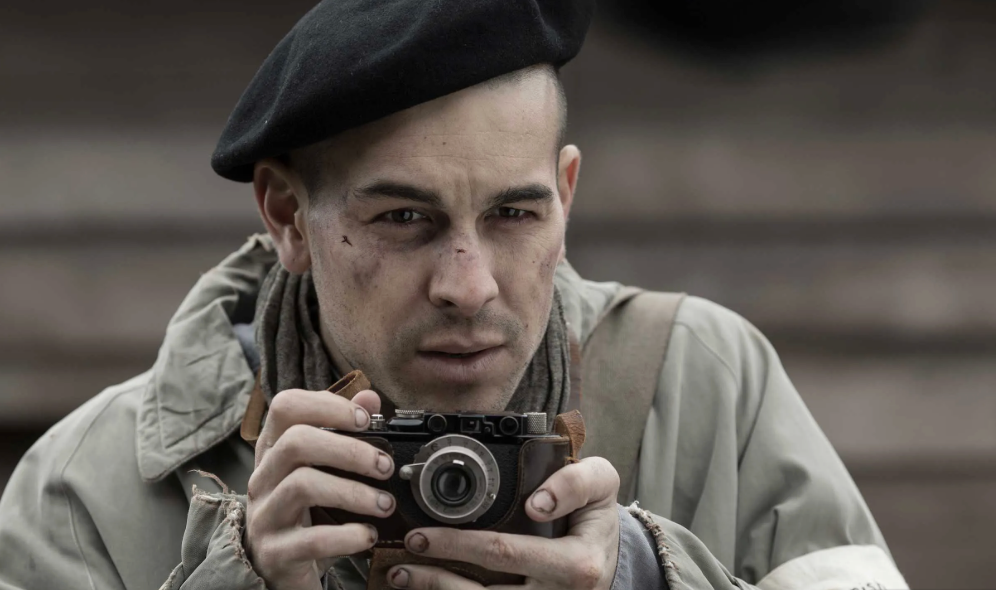
The intense Spanish historical drama The Photographer of Mauthausen (El fotógrafo de Mauthausen) continues to leave global streaming audiences stunned with its raw portrayal of survival, resistance, and historical truth.
Featuring a transformative performance by Mario Casas—who underwent an extreme physical transformation to portray real-life WWII figure Francesc Boix—the film recounts one of the most dangerous intelligence operations executed from inside a Nazi concentration camp.
A High-Stakes Mission Behind Barbed Wire
Francesc Boix was a young Catalan photographer and communist soldier who fled Spain after the Spanish Civil War, only to be captured in France and deported in 1941 to Mauthausen, a high-grade labor camp in Austria.
Because of his technical background in photojournalism, Boix was assigned to work inside the camp’s Erkennungsdienst (Identification Department). There, under the command of SS officers, he was forced to process photos of incoming prisoners, camp visits by high-ranking officials, and staged deaths.
Boix quickly recognized that these photographic records were incontrovertible proof of systematic war crimes and mass executions. As the tide of WWII turned in late 1944 and Nazi commanders ordered the complete destruction of all camp archives to cover their tracks, Boix and a secret network of Spanish political prisoners launched a desperate mission to save the film negatives before they could be incinerated.
Smuggling the Evidence
Over several months, Boix and his comrades stole, copied, and hid thousands of individual film negatives. The operation required astonishing bravery:
-
Inside the Laboratory: Prisoners working in the photo lab riskily pocketed negatives during processing shifts, hiding them in floorboards and darkroom equipment.
-
Smuggling Past the Guards: Young inmate couriers moved the hidden film out of the administrative sectors into the main camp barracks.
-
The External Hideout: Working with local Austrian anti-fascist Anna Pointner, prisoners smuggled the negatives past the camp perimeter wall, where Pointner hid them inside a stone wall near her property.
A single discovery by SS officers meant immediate torture and public execution for everyone involved. Despite the constant threat, Boix and the Spanish underground network managed to preserve approximately 2,000 photographic negatives.
The Ultimate Payoff: Nuremberg
When Allied forces liberated Mauthausen in May 1945, Boix retrieved the hidden negatives and immediately photographed the liberated camp and surviving prisoners.
The smuggled film did far more than preserve memory; it became decisive legal evidence. In 1946, Boix served as a key witness at the International Military Tribunal in Nuremberg—the only Spanish citizen to testify. Standing before international judges, he presented his photos as direct evidence, identifying senior Nazi leaders (including Ernst Kaltenbrunner and Albert Speer) and proving they had personal knowledge of Mauthausen’s atrocities.
The Photographer of Mauthausen delivers an unforgettable look at how courage and a camera lens ensured that the truth survived the darkest hours of history.