
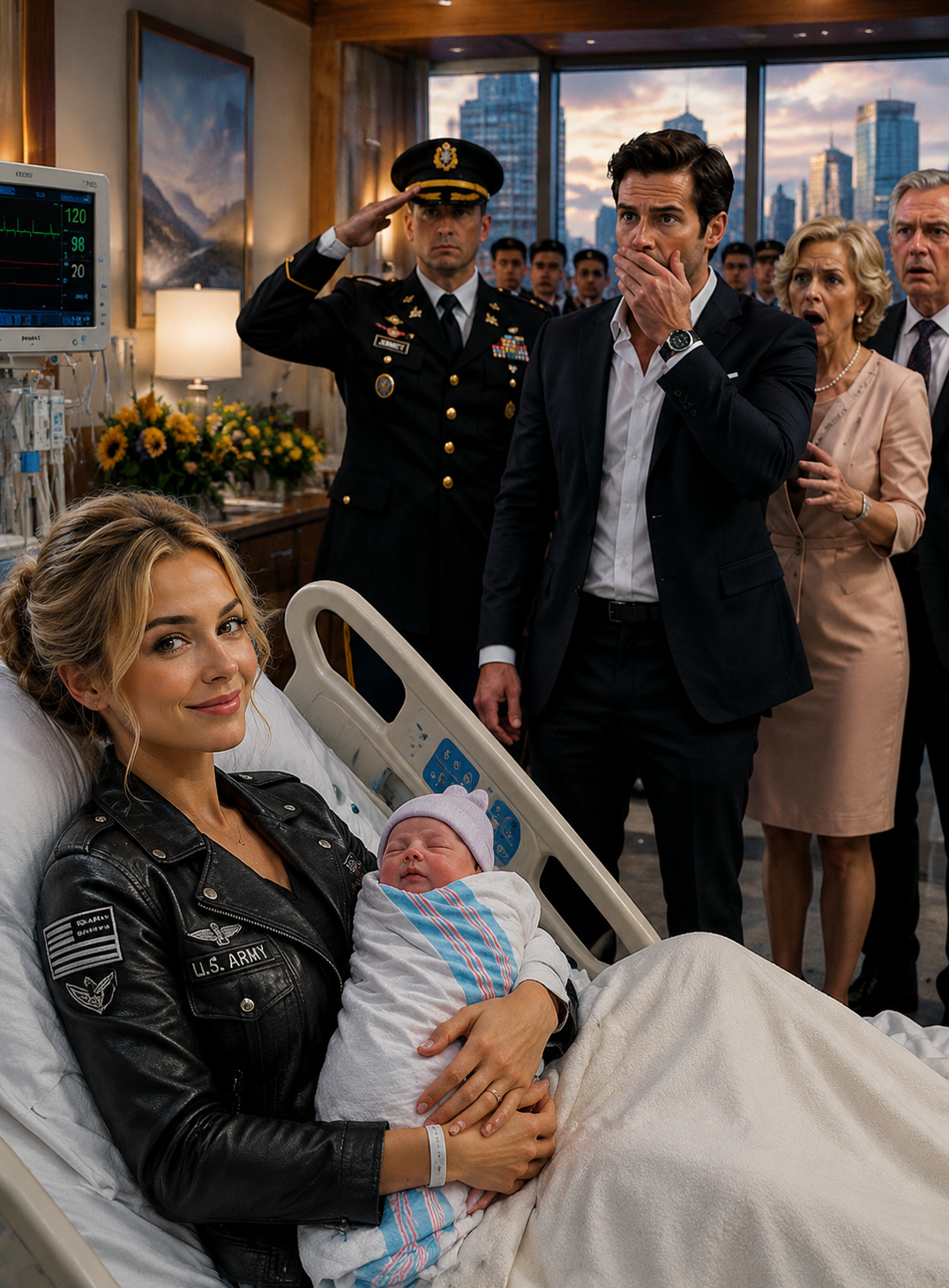
Brigadier General Marcus Bennett looked at Christopher for another moment, then quietly added, “You had six years to respect your wife. What happens next should be about learning how to respect the mother of your child.”
There was no threat in his voice.
That somehow made the words land harder.
Christopher glanced toward the elevators that led to the maternity floor.
“I just want to see Leo.”
“You may eventually have that opportunity,” Bennett replied. “But Colonel Rodriguez has asked for privacy while she recovers. The hospital will decide access according to her medical needs and its policies. Your attorneys can address everything else through the proper channels.”
Margaret folded her arms.
“This is a family matter.”
“It is,” Bennett said. “Which is precisely why I suggest everyone stop treating it like a business transaction.”
For once, Margaret had no answer.
Upstairs, I knew none of this yet.
I was sitting against a mountain of pillows while my nurse, Hannah, checked Leo’s temperature.
He had already settled again, his tiny cheek resting against my chest as though the chaos of the previous hour belonged to another universe.
Watching him breathe gave me something solid to focus on.
In.
Out.
In.
Out.
Everything else could wait.
When General Bennett finally entered my room, he came alone.
He removed his cap and placed it beneath one arm.
I had seen Marcus Bennett walk into command centers during emergencies with complete confidence. I had watched him brief generals and diplomats without hesitation.
But beside my hospital bed, he looked almost paternal.
“How are you really?” he asked.
“Tired.”
“That answer I believe.”
I looked toward the bassinet.
“I should have seen this coming.”
“No.”
“Christopher had been distant for months.”
“That doesn’t mean you were required to become a detective in your own marriage.”
I closed my eyes.
For years, I had been trained to notice unusual patterns.
A change in routine.
A missing piece of information.
A hesitation where certainty should have existed.
Yet at home, I had deliberately refused to analyze the man I loved.
I had believed trust required that.
Maybe it did.
Maybe trust simply required two people.
“I’m embarrassed,” I admitted.
Marcus pulled the visitor’s chair closer.
“About what?”
“About being surprised.”
“Valentina, betrayal isn’t evidence that the betrayed person lacked intelligence.”
I looked at him.
“You practicing therapy now?”
“Only badly.”
Despite everything, I smiled.
He nodded toward the papers still sitting untouched on the bedside table.
“Military legal assistance can advise you about certain protections and help you understand how your service intersects with the situation, but you’ll need a civilian family-law attorney for the divorce and custody issues.”
“I know.”
“I called someone.”
I raised an eyebrow.
“You said not to sign anything. You didn’t say you were assembling a legal team.”
“You called a brigadier general six hours after giving birth. I assumed subtlety was no longer required.”
That earned a tired laugh.
Marcus became serious again.
“Her name is Elena Park. She handled her own divorce while serving in the Judge Advocate General’s Corps before moving into private family practice. More importantly, she doesn’t turn divorces into wars unless someone leaves her no alternative.”
May you like

“That sounds useful.”
“She’ll meet you tomorrow if you want.”
I glanced at Leo.
Tomorrow.
The idea seemed impossible.
Six hours earlier, tomorrow had meant learning how to buckle an infant into a car seat.
Now it meant divorce attorneys.
Custody plans.
Housing.
Conversations with family.
Explaining to people that the marriage they thought I had was already gone.
“I want to meet her.”
Marcus stood.
“There’s something else.”
I waited.
“Christopher asked me whether he could speak with you privately.”
“No.”
“I assumed that was your answer.”
“Did he seem angry?”
“No.”
“Defensive?”
“Mostly lost.”
That surprised me.
I had imagined him downstairs surrounded by his parents, Jessica holding his arm, all of them continuing to speak about me as though I were a problem waiting to be managed.
“What did you tell him?”
“That when you were ready, he could ask again.”
I touched Leo’s dark hair with one finger.
“I’m not ready.”
“You don’t owe anyone readiness on their schedule.”
Marcus moved toward the door.
“Try to sleep.”
“General?”
He turned.
“Thank you.”
His expression softened.
“Valentina, I didn’t come because you’re a colonel.”
I frowned.
“I came because you called.”
Then he left.
Those words stayed with me long after the room became quiet.
Because that was the difference Christopher’s family had never understood.
Rank could open doors.
Authority could make people listen.
But neither could manufacture loyalty.
Loyalty was what remained when titles disappeared.
And for the first time in years, I began wondering who in my life would remain if mine did.
Elena Park arrived shortly after nine the next morning wearing a navy suit and carrying no visible stack of paperwork.
She was probably in her forties, with calm dark eyes and the unhurried manner of someone who knew frightened people needed clarity more than performance.
She shook my hand.
“Congratulations on your son.”
“Thank you.”
“And I’m sorry our first meeting is happening here.”
“So am I.”
She sat.
“Before we discuss anything else, I want you to understand one thing. Nobody determines permanent custody by walking into a hospital room and announcing that the baby stays with them.”
I felt something loosen inside my chest.
“I knew that logically.”
“But hearing it helps.”
“Yes.”
She nodded.
“Your husband is Leo’s father. Assuming there are no safety concerns, the legal system generally recognizes that both parents matter. What changes now is that decisions must be made carefully, formally, and in Leo’s best interests.”
“I’m not trying to keep Christopher from his son.”
“That’s important.”
“I’m trying to keep everyone from deciding things for me while I’m still wearing a hospital bracelet.”
“That is also important.”
Elena opened a thin folder.
“I’ve reviewed the documents William brought.”
“And?”
“They’re remarkably one-sided.”
“That sounds like William.”
“He’s offering you fifty thousand dollars, asking you to waive certain financial claims, proposing that Christopher receive primary physical custody, and attempting to define your military career as evidence that you are frequently unavailable.”
My stomach tightened.
“That last part was planned.”
“Yes.”
“How long?”
Elena studied me.
“The documents were prepared eleven days ago.”
Eleven days.
I looked at Leo.
Eleven days ago, Christopher had sat beside me at breakfast.
He had complained about burnt toast.
He had kissed my forehead before leaving for work.
That evening he rubbed my swollen feet while we watched television.
I suddenly remembered how quiet he had been.
“How long has he been with Jessica?”
“That I don’t know.”
“I do.”
I swallowed.
“Long enough to go to Paris.”
Elena waited without pushing me.
“What do you recommend?”
“Today? Recover.”
“And legally?”
“Do not communicate about money or custody without keeping a record. Do not sign anything. Do not agree verbally to permanent arrangements. Once you’re discharged, we establish a temporary parenting framework that protects Leo’s routine and allows both parents appropriate involvement.”
I stared at the envelope containing William’s offer.
“What about the divorce?”
“You decide whether you want one.”
I laughed softly.
“He brought his mistress to the hospital.”
“I’m not suggesting reconciliation. I’m reminding you that this decision belongs to you, not Christopher, Jessica, Margaret, William, me, or General Bennett.”
For the first time since the papers hit my bed, someone had returned the choice to me.
That mattered more than I expected.
Elena stood.
“There’s one more question.”
“What?”
“Why does Christopher’s family believe you need fifty thousand dollars?”
I nearly smiled.
“Because I never corrected them.”
“Why?”
The answer was more complicated than I wanted it to be.
“Because early in our marriage, Christopher liked that I wasn’t impressed by his family’s money. Then his parents started making comments about my government salary. Christopher would tell me to ignore them.”
“And you did.”
“For six years.”
“Did Christopher know your actual rank?”
“Yes.”
“Your salary?”
“Mostly.”
“Your responsibilities?”
“Not everything. Some assignments were classified, and some things weren’t appropriate dinner conversation.”
“But he understood you were senior Army leadership.”
“Absolutely.”
Elena tilted her head.
“Then his parents’ misunderstanding wasn’t entirely yours to correct.”
That sentence followed me for the rest of the day.
Christopher had let them believe I was insignificant.
Why?
Convenience?
Cowardice?
Or had it simply been easier for him to remain the impressive son when his wife’s accomplishments stayed invisible?
My mother arrived that afternoon from New Mexico.
Lucia Rodriguez walked into the room carrying two bags, three containers of homemade food hospital rules would probably forbid, and enough concern to fill the building.
She stopped beside Leo.
Her entire face changed.
“Oh.”
That one syllable contained more love than most speeches.
I handed him to her carefully.
“Meet your grandson.”
She took him as though he were made of sunlight.
“Hola, mi amor.”
Then she looked at me.
Her eyes filled.
I knew what was coming.
“Mom.”
“I’m not crying.”
“You’re crying.”
“I flew three hours. My eyes are dry.”
“Sure.”
She kissed Leo’s forehead.
For twenty minutes, she asked nothing about Christopher.
That was one of the reasons I had called her after Bennett.
My mother had spent thirty-two years teaching elementary school children.
She believed most problems improved if people ate something, slept, and stopped talking before they said something permanent.
Eventually, Leo returned to his bassinet.
Mom pulled her chair beside my bed.
“Tell me.”
I did.
Not dramatically.
Not all at once.
I told her about Jessica.
The ring.
Paris.
The papers.
The money.
William wanting Leo to remain with Christopher.
Mom listened without interrupting.
When I finished, she folded her hands.
“Do you want me to say what I think of Christopher?”
“No.”
“Good. Because I promised God during the flight I would control my vocabulary.”
I laughed despite myself.
Then she asked, “Do you still love him?”
The question hurt more than I expected.
“I don’t know.”
“That means yes.”
“It means I don’t know.”
“You can love someone and decide they cannot continue being your husband.”
I looked away.
“I feel stupid.”
“That part I won’t allow.”
“Mom—”
“You loved him. That is not stupidity.”
“He made me look foolish.”
“No. He behaved foolishly. Different thing.”
I blinked hard.
She reached for my hand.
“What do you want now?”
I looked at Leo.
“Peace.”
“Then build decisions around that.”
Not winning.
Not punishing Christopher.
Not proving something to his parents.
Peace.
It sounded almost too small for what had happened.
Maybe that was why it felt possible.
Christopher did not contact me directly for two days.
He sent messages through Elena asking whether he could visit Leo.
The first time, I said no.
The second time, I almost said no again.
Then I stopped.
Leo deserved a father if Christopher was willing to become one.
And I needed to learn whether he was.
So on the morning I was discharged, Christopher entered my room alone.
No Margaret.
No William.
No Jessica.
He looked as though he had barely slept.
His eyes went immediately to Leo.
For a moment, neither of us spoke.
Then Christopher whispered, “He looks different.”
“He’s three days older.”
“I know.”
His mouth trembled slightly.
“I missed three days.”
I watched him carefully.
“You chose to.”
He nodded.
No excuse.
That surprised me.
“Can I hold him?”
I hesitated before handing Leo over.
Christopher supported his head awkwardly, nervous in a way I had never seen before.
Leo opened his eyes.
Christopher stared down.
“Hey.”
His voice cracked.
I turned toward the window.
I did not want his love for our son to soften my understanding of what he had done to me.
Both things could exist.
He could have betrayed me.
He could also love Leo.
Life rarely sorted people into convenient categories.
Christopher sat for nearly ten minutes before speaking again.
“My parents shouldn’t have come.”
“No.”
“Jessica shouldn’t have come.”
“No.”
“I shouldn’t have served you papers here.”
“No.”
He looked at me.
“I’m sorry.”
Three days earlier, those words might have shattered me.
Now they seemed strangely small.
“Why?”
He frowned.
“What?”
“Why are you sorry? Because it hurt me? Because it looked terrible? Because Bennett embarrassed you? Because your attorney told you custody doesn’t work the way your father thought?”
His face tightened at the word embarrassed.
“Bennett didn’t embarrass me.”
“Good.”
“My father did.”
I waited.
Christopher looked down at Leo.
“I didn’t know Dad had included primary custody in those papers.”
I stared at him.
“You expect me to believe that?”
“I knew he had documents prepared. I knew about the settlement. I knew he wanted everything handled quickly.”
“But not Leo?”
“No.”
“You stood there.”
“I froze.”
“You let your mother reach for him.”
“I know.”
I felt my anger returning—not explosive, but cold and clear.
“That may be worse, Christopher.”
“I know.”
“No, I don’t think you do. You were the one person in that room who had promised to protect us both.”
His eyes closed.
“I know.”
Leo made a soft noise.
Christopher adjusted him carefully.
I noticed that his hands were trembling.
“When did Jessica get my ring?”
His face changed.
“She took it.”
“From my jewelry box?”
“I think so.”
“You think so?”
“I never gave it to her.”
“But you let her wear it.”
His silence answered.
“How long?”
“Eight months.”
Eight months.
I felt something inside me settle.
Not break.
Settle.
Maybe the heart does not always shatter when it finally receives the truth.
Sometimes it simply stops arguing with itself.
“Paris?”
“Yes.”
“Other trips?”
“Yes.”
I nodded.
“Thank you.”
He looked confused.
“For what?”
“For finally not lying.”
Christopher stared at Leo.
“I ended things with Jessica yesterday.”
I almost laughed.
“That has nothing to do with me.”
“I know.”
“Does she?”
His jaw tightened.
“She knows now.”
There was something strange in his voice.
“What happened?”
“Nothing dramatic. She thought once the divorce started we would move into the house in Connecticut.”
“What house?”
Christopher went still.
Then he looked at me.
“Our house.”
“We don’t own a house in Connecticut.”
“My parents do.”
That answer bothered me more than it should have.
“Why did Jessica think you were moving there?”
“Because my mother told her.”
I stared at him.
“You discussed your future with your mistress and your mother.”
Christopher looked ashamed.
“Yes.”
“And somehow I was the last person invited into the conversation about my marriage.”
“Yes.”
Leo began fussing.
Christopher tried rocking him.
To my surprise, Leo quieted.
I watched them.
“I need you to understand something,” I said.
Christopher met my eyes.
“I’m filing for divorce.”
His face fell.
He had come expecting it.
Some part of him had apparently still hoped otherwise.
“I understand.”
“No, I need you to actually understand. I’m not doing it because your parents insulted my career. I’m not doing it because Jessica wore my ring. I’m doing it because for eight months you created a second life and came home every night expecting me to live inside the first one.”
He looked down.
“I know.”
“And I will not raise Leo in a home where love requires pretending.”
A long silence followed.
Then Christopher said, “I don’t want to fight you for him.”
I studied him.
“What do you want?”
“To be his father.”
That was the first answer he had given me that sounded completely honest.
“Then prove that by showing up.”
“I will.”
“Not with gifts.”
“I understand.”
“Not by having your mother make decisions.”
His mouth tightened.
“I understand.”
“Not by turning custody into a contest.”
“I won’t.”
I nodded.
“We’ll work through Elena.”
He carefully returned Leo to me.
At the doorway, Christopher stopped.
“There’s something I need to tell you.”
I waited.
“My father didn’t come up with the fifty thousand dollars because he thinks that’s what you need.”
“Then why?”
Christopher looked uncomfortable.
“Because he thinks that’s what you’ll accept.”
“That sounds identical.”
“It isn’t.”
He left before explaining.
The first week home was both exhausting and unexpectedly quiet.
Mom stayed in the guest room.
Marcus arranged for my scheduled leave to remain completely protected from unnecessary work interruptions.
Elena dealt with legal communication.
I dealt with Leo.
He seemed unaware that adults had turned his arrival into a complicated rearrangement of everyone’s future.
He ate.
Slept.
Woke.
Stretched.
Made tiny expressions that convinced my mother he was already developing a sophisticated personality.
At three in the morning, hierarchy disappeared.
I wasn’t Colonel Rodriguez.
I wasn’t Christopher’s wife.
I wasn’t the woman Margaret had dismissed.
I was simply Leo’s mother, standing in a dim nursery with an eight-pound human being who had somehow become the center of my universe.
Christopher visited according to the temporary schedule Elena helped us create.
At first, I watched everything.
How he held Leo.
Whether he remembered bottles.
Whether he checked his phone.
Whether he waited for instructions.
But something slowly changed.
Christopher began arriving early.
He learned how to change diapers.
He kept a note on his phone listing feeding times.
He stopped asking me whether every sound Leo made was normal and started reading the pediatrician’s materials himself.
One afternoon, I found him asleep in the rocking chair with Leo safely resting in the bassinet beside him.
For a moment, I remembered the man I had married.
That was difficult.
Hatred would have been easier.
But I didn’t hate him.
I simply no longer trusted him with my heart.
Those were different things.
Margaret asked to visit when Leo was two weeks old.
I refused twice.
The third request came as a handwritten letter.
Not a text.
Not a message through Christopher.
A letter.
Valentina,
I behaved terribly at the hospital.
There is no excuse for reaching toward Leo after you told me not to. I allowed my fear about my son’s future to become disrespect toward you as his mother.
I would like to apologize in person when you are ready.
I am not asking you to forgive me.
Margaret
I read it three times.
Mom sat across the kitchen table feeding Leo a bottle.
“What do you think?” I asked.
“I think she used the word apologize without including the word but.”
“That surprised me too.”
“Progress.”
“You think I should let her come?”
“I think you should do whatever leaves you most peaceful afterward.”
There was that word again.
Peace.
So I agreed.
Margaret arrived alone.
No designer handbag.
No dramatic entrance.
She carried a small wooden box.
We sat in the living room while Mom took Leo upstairs.
Margaret noticed.
“I’m not seeing him?”
“Not yet.”
She nodded.
“That’s fair.”
Another surprise.
For several seconds we sat in uncomfortable silence.
Finally, Margaret placed the box on the coffee table.
“This belonged to Christopher when he was a baby.”
Inside was a silver rattle, faded photographs, and a hospital bracelet with Christopher’s name.
“I thought Leo might have them someday.”
“Thank you.”
She folded her hands.
“I’m sorry.”
I studied her.
“At the hospital?”
“For much longer than that.”
I said nothing.
She continued.
“I treated your career like it was a hobby because you never talked about it.”
“That was your assumption.”
“I know.”
“I didn’t hide my service.”
“No.”
“Christopher knew.”
“Yes.”
Her expression changed slightly.
That caught my attention.
“Margaret?”
She looked toward the staircase.
“When Christopher first brought you home, William was intimidated by you.”
I almost laughed.
“William?”
“He’d never admit it.”
“Why?”
“Because you didn’t need anything from us.”
That answer surprised me.
She gave a sad smile.
“You were twenty-eight. Decorated. Independent. Christopher looked at you as though you had shown him a larger world existed outside our family.”
“That sounds unlike William’s problem.”
“It became his problem because Christopher had spent his whole life looking to his father before making decisions.”
I leaned back.
“And William blamed me for changing that?”
“At first.”
“What changed?”
“Christopher stopped changing.”
The room became quiet.
Margaret looked genuinely sad.
“He loved you. I believe he still does. But somewhere along the way he became afraid he wasn’t enough for you.”
“That doesn’t explain Jessica.”
“No.”
Margaret shook her head.
“Nothing explains Jessica except Christopher making selfish choices.”
That might have been the first time I heard her criticize her son without qualification.
She stood.
“I won’t defend him.”
“Thank you.”
“But there is something you should ask William.”
I frowned.
“What?”
“Why the settlement was fifty thousand dollars.”
Christopher had said almost the same thing.
“What does that mean?”
Margaret hesitated.
Then she picked up her coat.
“It means my husband has been making decisions around money he thinks belongs to him.”
Before I could ask more, she left.
That evening, I called Elena.
She listened while I explained.
“Do you have access to your joint financial accounts?” she asked.
“Yes.”
“Have you reviewed them recently?”
“Not closely.”
“Do that.”
My stomach tightened.
“You think Christopher moved money?”
“I think we should avoid assuming anything.”
That was lawyer language for something worried her.
I opened our accounts after Leo fell asleep.
Checking.
Savings.
Mortgage.
Investments.
Nothing obvious.
Then I remembered an account I almost never used.
Six years earlier, after our wedding, Christopher and I had created a joint brokerage account.
We deposited wedding gifts into it and largely forgot about it.
I opened the statement.
The balance made me stare.
$1,842,607.
I called Elena immediately.
“That isn’t possible.”
“Why?”
“We started with maybe ninety thousand.”
“Investments can grow.”
“Not like that.”
“Look at transaction history.”
I did.
There were deposits.
Large ones.
Some from Christopher.
Others from a holding company I didn’t recognize.
“Park Crescent Holdings.”
Elena went silent.
“What?”
“I saw that name in the disclosures your husband’s attorney sent this afternoon.”
“What is it?”
“A company controlled by William.”
My pulse quickened.
“How much did it deposit?”
I scrolled.
Over six years, nearly seven hundred thousand dollars.
Elena spoke carefully.
“Do not move anything tonight.”
“I wasn’t going to.”
“Send me the statements.”
I did.
The next morning she called.
“Valentina, I need you to come to my office when you can.”
My mother watched Leo while I drove downtown.
Elena had three folders waiting.
“There’s something unusual,” she said.
“About the account?”
“Yes.”
She pushed a copy of the original account agreement toward me.
I recognized Christopher’s signature.
Then mine.
“What am I looking for?”
“The ownership structure.”
“Joint tenants.”
“Yes.”
“So?”
“So William appears to have transferred money into an account legally owned by you and Christopher.”
“Why?”
“That’s what I wanted to know.”
She handed me another document.
It was an email from William’s financial manager to Christopher, dated four years earlier.
Chris,
Per your father’s instruction, quarterly distributions should continue through Park Crescent into the joint Rodriguez account. William wants these treated as family transfers rather than compensation.
My hands became cold.
“What family transfers?”
Elena gave me the final folder.
“Christopher is the beneficiary of a family trust.”
“I knew that.”
“What you may not have known is that after your marriage, William began directing part of Christopher’s distributions into the account bearing both your names.”
I stared at her.
“Why would he do that if he disliked me?”
“That’s the question.”
Then Elena pointed to a handwritten note copied from William’s own financial records.
My name appeared beside one sentence.
For V.R. — agreed marital allocation.
I read it twice.
“Agreed with whom?”
“We don’t know.”
“Christopher?”
“Possibly.”
I shook my head.
“This still doesn’t explain fifty thousand.”
Elena’s expression became thoughtful.
“Actually, it might.”
She moved another page toward me.
“The divorce agreement William brought to the hospital included language that would have transferred your interest in several joint assets back to Christopher.”
“In exchange for fifty thousand dollars?”
“Yes.”
“How much is my actual interest?”
“That will require forensic accounting.”
“Estimate.”
She paused.
“Potentially several hundred thousand dollars. Possibly more.”
I sat very still.
Suddenly the hospital room looked different in my memory.
The briefcase.
The papers.
The urgency.
Sign.
Take fifty thousand.
Leave.
I had believed William thought I was poor.
Maybe that wasn’t the point.
Maybe he was afraid I would discover I wasn’t.
Christopher arrived for his visit that evening.
I waited until Leo was asleep.
Then I placed the account statement on the kitchen island.
Christopher stopped.
“You found it.”
Those three words told me everything.
“You knew.”
“Yes.”
“How long?”
“From the beginning.”
“Why didn’t you tell me?”
He rubbed a hand over his face.
“Because the money wasn’t supposed to matter.”
“That might be the stupidest sentence you’ve said all month.”
“I know.”
“Why was your father depositing trust money into an account with my name?”
Christopher stared at the statement.
“When we got married, my grandfather was still alive.”
I vaguely remembered Harold Whitmore.
Quiet.
Kind.
The only member of Christopher’s wealthy family who asked me more questions about books than money.
“He liked you,” Christopher said.
“I liked him.”
“He rewrote part of the trust after our wedding.”
I frowned.
“How?”
“He required a percentage of my distributions to become marital assets.”
I stared at him.
“Why?”
Christopher gave a small, painful smile.
“Because he didn’t trust my father.”
The room suddenly seemed very quiet.
“What does that mean?”
“Granddad believed Dad used money to control everyone. He wanted whoever I married to have independent security.”
“Did William know?”
“Of course.”
“And hated it.”
“Yes.”
I looked toward the ceiling, thinking.
“So the fifty-thousand-dollar offer…”
“Was my father trying to get you to surrender claims before you understood what Granddad had done.”
My anger rose again, but beneath it was something else.
Confusion.
“Why would you allow that?”
Christopher’s eyes filled with shame.
“I didn’t understand what Dad had put in the agreement.”
“You didn’t read it?”
“I read the first pages.”
I stared.
“You were divorcing me and didn’t read the agreement?”
“I wanted everything finished.”
“That isn’t an answer.”
“I was a coward, Valentina.”
The simplicity of it silenced me.
Christopher took a breath.
“I had Jessica telling me we should start our life. My mother telling me you would never forgive me anyway. Dad saying lawyers would handle everything. And I kept choosing whatever avoided the hardest conversation.”
“With me.”
“Yes.”
“Why didn’t you simply tell me you were unhappy?”
His voice dropped.
“Because I wasn’t unhappy with you.”
That hurt in a different way.
“Then why?”
He looked toward the nursery.
“Because I was unhappy with myself.”
I said nothing.
“When we married, I loved telling people my wife was in the Army. Then you got promoted. And promoted again.”
His eyes met mine.
“I was proud of you.”
“But?”
“But everyone who met you saw something in you.”
“Christopher—”
“Let me finish.”
I folded my arms.
He continued.
“You knew who you were. You could walk into a room full of generals or my father’s friends and be exactly the same person. I had spent my whole life trying to impress people.”