
PART 3
Nathan sat across from me at the kitchen table while our dinner slowly cooled between us.
For several seconds, neither of us spoke.
Then he finally said, “My dad spent more than thirty years in uniform. Most of the last part of his career was at Fort Harrove.”
“I know the name Bennett.”
Nathan looked up sharply.
“You do?”
“I’ve read enough archived command reports to recognize it.”
That was putting it mildly.
Richard Bennett’s name appeared throughout Fort Harrove’s institutional history.
Facility expansion plans.
Training assessments.
Modernization proposals.
Operational reviews.
And more than a few memorandums written in the unmistakable voice of a man who did not particularly enjoy being contradicted.
Some of his recommendations had been excellent.
Others had aged less gracefully.
Nathan pushed his untouched noodles around with a fork.
“He loved that base.”
“That doesn’t sound like a problem.”
“The way he left was.”
I stopped eating.
Nathan leaned back.
“A few years ago, the regional command structure was reorganized. Positions disappeared. Responsibilities were consolidated. Dad wasn’t fired or disciplined or anything like that, but…”
“He was encouraged to retire.”
Nathan nodded.
“Earlier than he wanted.”
That explained considerably more than he probably realized.
Military retirement looked clean on paper.
A ceremony.
A folded flag.
A speech about service.
Handshakes.
Photographs.
Then everyone went home.
But careers rarely ended as neatly as ceremonies suggested.
For some people, taking off the uniform meant beginning another chapter.
For others, it felt like being erased from a story they believed still belonged to them.
Nathan stared toward the rain sliding down my kitchen window.
“He never really got over it.”
I said nothing.
“He still follows everything happening at Harrove. Every leadership change. Every restructuring. Every new policy.”
“And he approves of all of them, naturally.”
Nathan gave me a tired smile.
“Exactly none of them.”
I leaned back.
“Does he know Fort Harrove has a new commander?”
“Yes.”
I waited.
Nathan suddenly became fascinated by his spring roll.
“And?”
“He had opinions.”
“Nathan.”
“He said he hoped they finally gave the position to somebody serious.”
I stared at him.
He covered his face.
“I knew you were going to make that expression.”
“What expression?”
“The one where you look like you’re deciding whether my father can be recalled to active duty specifically so you can assign him to inventory management.”
“I was thinking snow removal.”
“In November?”
“Builds character.”
Nathan laughed despite himself.
I didn’t.
Not for long.
Because another question had occurred to me.
“Why doesn’t he know who I am?”
Nathan’s smile vanished.
“When we started dating, I wanted my parents to meet Rebecca.”
“Rebecca happens to be a colonel.”
“You know what I mean.”
Unfortunately, I did.
He reached across the table.
“People act differently around you when they know.”
“That’s their problem.”
“I know. But my father would have turned our first dinner into a promotion board.”
“So instead you let him believe I was a junior officer?”
Nathan hesitated.
“Yes.”
“For two years?”
Another pause.
“Yes.”
I folded my arms.
“That bothers me more than anything your father thinks.”
Nathan looked genuinely surprised.
“I wasn’t ashamed of you.”
“I didn’t say you were.”
“But you thought—”
“No. I think you made a decision about my identity because managing your father was easier than trusting me to manage him myself.”
That landed.
Nathan looked down.
“You’re right.”
Rain tapped against the glass.
Finally I said, “We’ll go Saturday.”
His shoulders relaxed.
“But.”
They tightened again.
“I am not pretending to be something I’m not.”
“I wouldn’t ask you to.”
“You already have.”
He winced.
Fair enough.
“I won’t walk through the door announcing my rank,” I continued. “I won’t turn dinner into a briefing. But if he asks me directly, I’m answering honestly.”
Nathan nodded.
“Agreed.”
“And afterward, you and I are discussing why you thought this was a good idea.”
“Also agreed.”
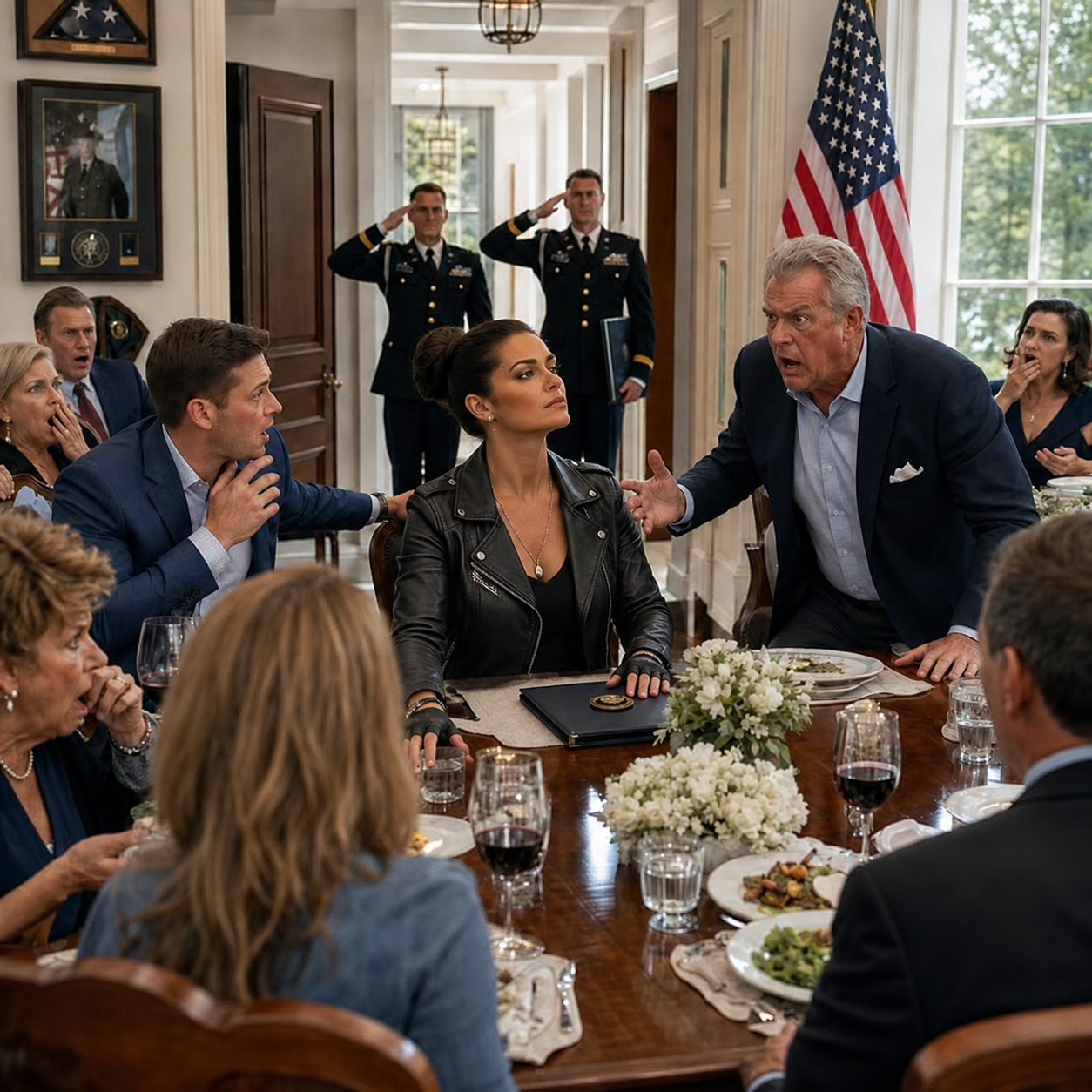
Saturday arrived cold and bright.
Nathan drove us through quiet suburban streets while dry leaves rolled across the pavement.
His parents lived in an old colonial house beneath enormous oak trees. An American flag moved gently above the porch.
Before Nathan could knock, the door opened.
Richard Bennett stood there.
Silver hair.
Straight shoulders.
Sharp eyes.
Retirement had removed the uniform.
It had not removed the officer.
He hugged Nathan briefly, then looked at me.
His eyes traveled from my face to my civilian coat.
He extended a hand.
“So you’re Rebecca.”
“I am.”
His handshake was firm.
Evaluating.
Then he asked the question Nathan had spent the entire drive praying he wouldn’t ask.
“Lieutenant?”
Beside me, Nathan made a faint choking sound.
I looked directly at Richard.
He waited.
And I remembered the promise I had made.
I wasn’t going to lie.