
Part 3 — The Twelve Seconds Everyone Saw
I barely slept that night.
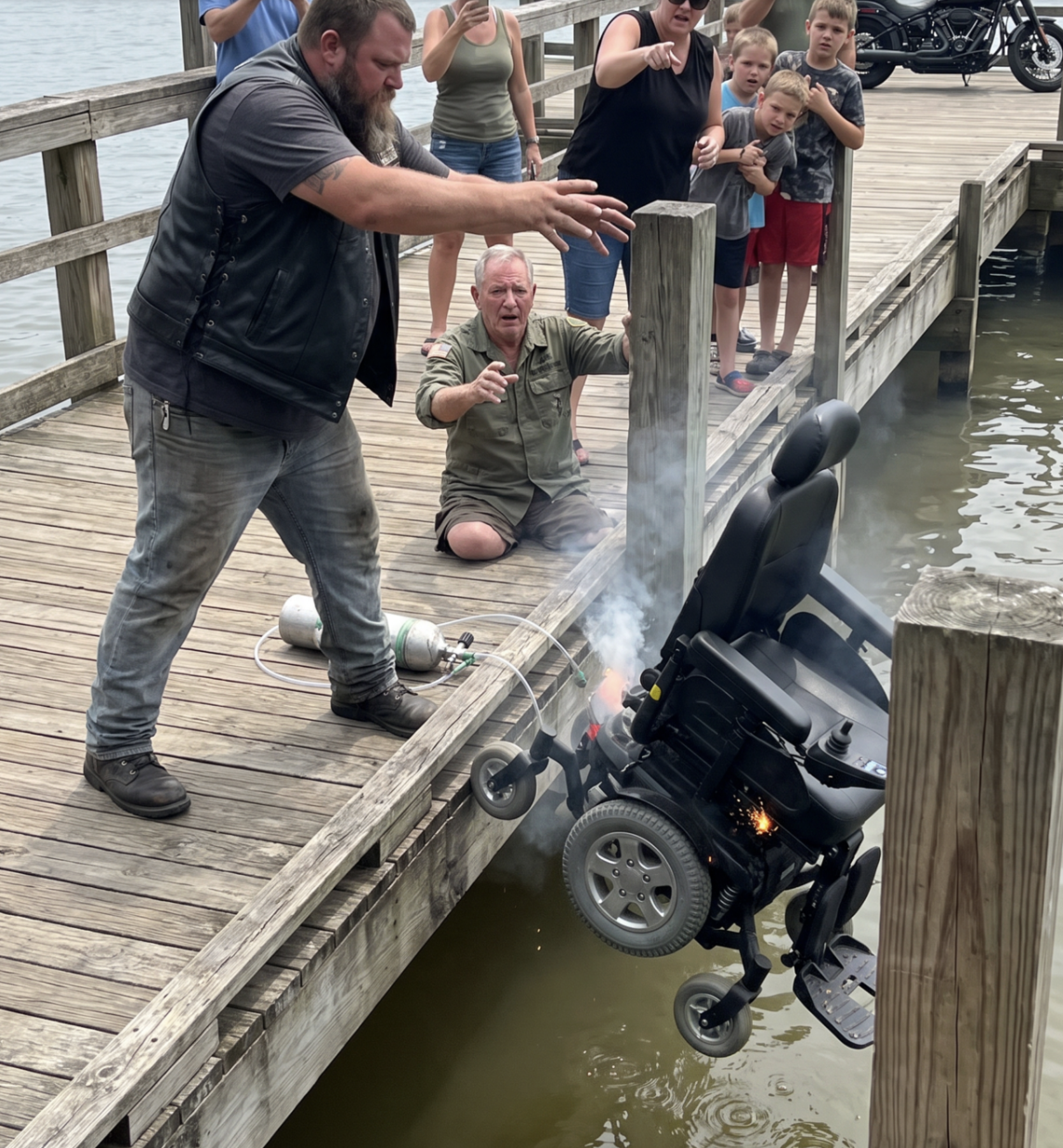
The video kept appearing on my phone. Each upload carried a different accusation, but the same twelve seconds played repeatedly: Hammer lifting Walt, the veteran’s arm striking the biker’s chest, the chair rolling toward the edge, and Walt shouting about his wife.
Context moved slowly.
Anger had better wheels.
At 6:12 the next morning, I returned to Riverbend Landing to meet the county inspector. Hammer’s Harley was already parked behind the bait shop.
He sat on the curb with two coffees.
One was black.
Walt drank his coffee black.
“You expecting him?” I asked.
“Hope ain’t expectation.”
Hammer handed me the second cup and walked toward the dock closure. Beneath his cut, his right shoulder sat lower than the left. Walt had not injured him by punching his mouth.
The lift had done it.
Hammer had torn something while pulling the veteran sideways from the chair. He refused a hospital because the club’s medical reserve contained only $3,840, and they might need every dollar before morning ended.
Moses arrived in his pickup.
He brought the rest of the Iron Saints’ officers with him—Doc Ellison, Colt Reyes, and June “Switch” Harlan, a fifty-three-year-old machinist who rode a pearl-gray Heritage Classic and handled the club’s accounts.
They did not greet Hammer.
Moses placed his phone on the hood. The viral video had reached six million views. Three veterans’ organizations had asked whether the Iron Saints condoned humiliating disabled people, and a hospital had canceled their scheduled toy run.
“We issue a statement,” Moses said. “We explain the battery. We release Doc’s photographs.”
Hammer shook his head.
“Not before Walt sees them.”
“He already thinks you destroyed his chair.”
“Was his chair.”
“It was also a bomb under an oxygen tank.”
“Still his story.”
Moses stepped closer. “The club may lose fourteen years of work because you won’t defend yourself.”
Hammer’s chain wallet clicked when he shifted his weight.
“Then we lose it.”
Colt swore and walked away.
Switch opened a folder. She had located a rehabilitation supplier in Knoxville with a demonstration power chair close to Walt’s measurements. The supplier would release it for $15,600 after applying every discount Doc could negotiate.
The Iron Saints had $17,240 in their clubhouse roof fund.
Rain had been entering the back room for nine months. The next storm could ruin their tools, donated medical equipment, and motorcycle lifts.
Switch asked for a vote.
Moses said the club should establish a public fundraiser first. Colt wanted to wait for the repairman’s insurance. Doc believed Walt needed powered mobility immediately, but taking nearly the entire roof fund could cripple their workshop.
Everyone looked at Hammer.
He did not command the club by giving speeches. He was president because, when a decision became ugly, he stood where the consequences would land.
“Buy it,” he said.
Moses folded his arms. “Easy to spend a brother’s dry roof.”
Hammer removed the president patch from his cut and placed it on the truck hood.
“Then don’t spend it for me.”
The small stitched rectangle lay beside the phone displaying his face beneath the word MONSTER.
No one spoke.
Hammer turned toward his motorcycle.
Moses caught his vest.
“You walk away every time staying gets difficult.”
Hammer stopped.
That sentence had not come from Moses.
It had come from Thomas Dawson.
Before dying, Hammer’s father had written it in a letter Ray never answered. Thomas described the bridge operation, Walt’s sacrifice, and the shame that followed him home. He admitted that he had drowned his guilt in whiskey while another man learned to live without legs.
Ray had kept the letter inside his saddlebag.
He had never finished reading it.
Moses had.
The club voted again.
Four hands rose.
Unanimous.
Switch called Knoxville. The supplier agreed to open on Sunday if someone arrived before nine. Colt took the club’s cargo trailer. Doc gathered Walt’s seating measurements from Helen’s folder.
Hammer went to retrieve the only object he had inherited from his father.
Meanwhile, Walt awakened in a house no longer designed for him.
His power chair had allowed him to transfer between the bedroom, bathroom, kitchen, and van without another person. The borrowed manual chair was too wide for the hallway and too low for his transfer board.
He spent the night in his recliner.
At 5:40 a.m., he tried to reach the bathroom alone.
The chair rolled backward.
Walt fell.
His neighbor found him on the floor forty minutes later, furious and humiliated but not seriously injured. An ambulance took him to Erlanger Hospital for examination.
The same viral video played on a television in the emergency waiting room.
Walt demanded that the nurse turn it off.
Then he asked to see the full recording.
A teenager at the lake had captured forty-seven seconds rather than twelve. His version showed the white vapor, Hammer clearing the oxygen tube, the underwater flash, and the biker shielding a little girl when hot fragments struck the surface.
The teenager’s mother uploaded it at Walt’s request.
The second video began spreading.
People who had called Hammer a monster changed their captions without apologizing. News stations added words like HERO and QUICK-THINKING BIKER.
Hammer disliked that version too.
“He had six million enemies yesterday,” Colt told me. “Today he’s got six million people who think he can’t make a mistake. Same cage. Different paint.”
At 10:35 a.m., Deputy Ortiz announced that no charges would be filed. The county did cite the mobile repair company whose bypassed sensors caused the failure.
That should have been the ending.
The veteran was alive. The biker had been vindicated. The dangerous chair had been recovered.
But Walt still had no independent mobility.
The hospital could not release him until a suitable chair or home-care plan existed. Insurance estimated six to twelve weeks for replacement approval.
Hammer stood outside the emergency department carrying his father’s unopened letter and the old red-and-gold unit insignia from his Harley.
He had one day to repair a debt older than he was.
Then Switch called from Knoxville.
The demonstration chair had been sold twenty minutes before Colt arrived.
Another buyer had paid full price.
The Iron Saints’ roof money could no longer solve the problem.
Moses looked at Hammer’s damaged shoulder and the empty trailer behind Colt’s truck.
“What now, President?”
Hammer put the patch back on his vest.
“Now we build.”