
Part 2 — The Smell Hammer Never Forgot
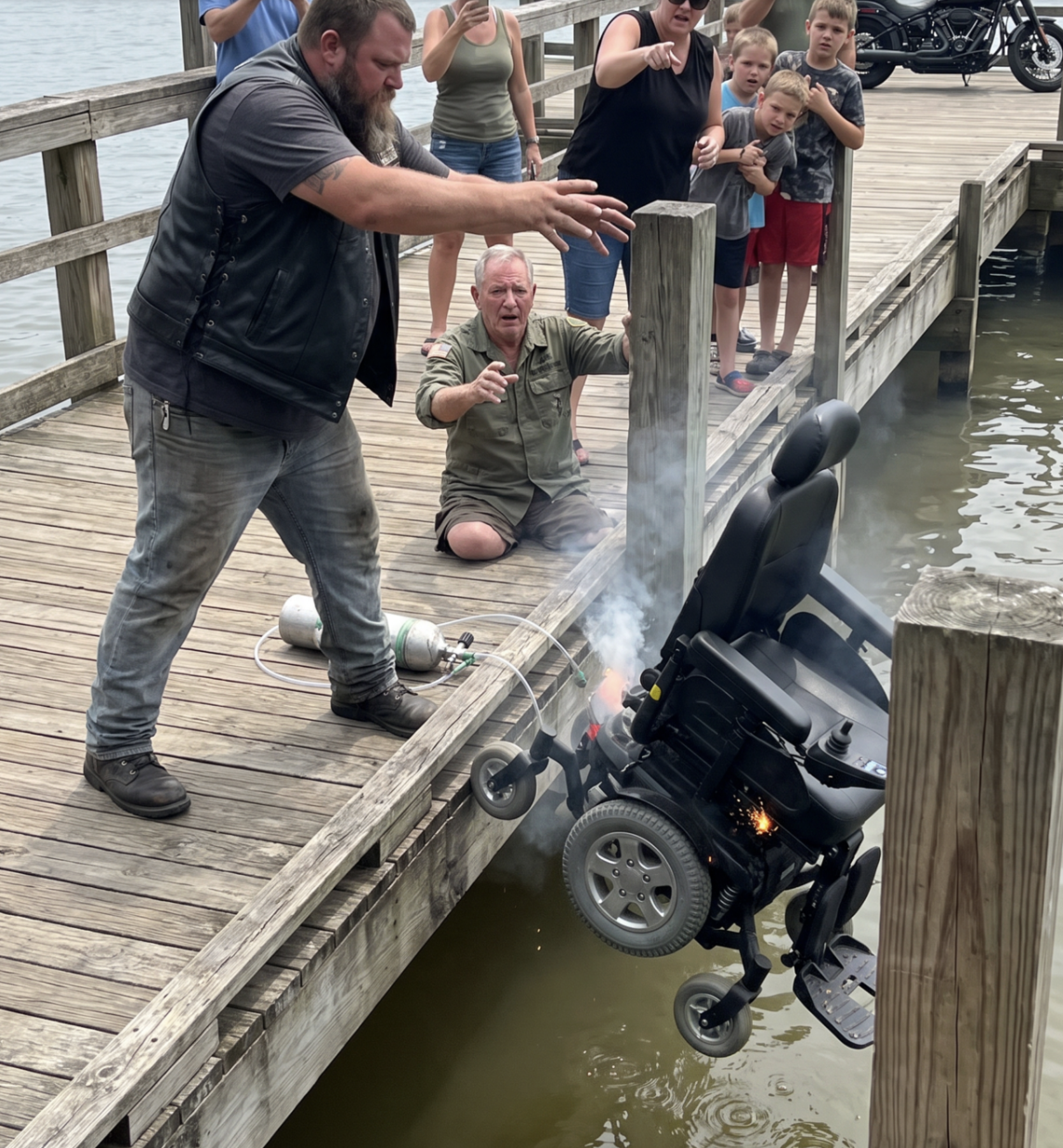
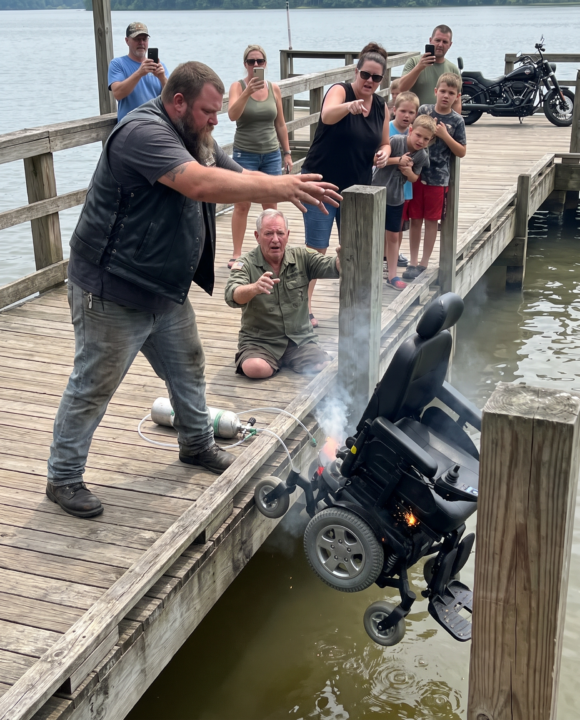
The sheriff’s deputies kept us at Riverbend Landing until nearly four that afternoon. The county fire team blocked the accessible dock, a hazardous-materials officer sampled the water, and two rescue divers eventually secured the wheelchair beneath a containment tarp before moving it into a steel recovery bin.
Walt sat beneath the diner awning in a borrowed manual chair.
He hated it.
His shoulders had deteriorated after years of compensating for his missing legs, so pushing himself more than twenty feet left him breathless. Every time somebody offered assistance, he planted both hands on the rims and told them he had survived worse machinery than a wheelchair.
Hammer waited beside his Harley.
Deputy Lena Ortiz questioned him three times. His answers never changed.
“I heard the cell pop.”
“I smelled electrolyte.”
“I saw vapor.”
“I moved the man.”
When she asked why he had thrown the chair into public water, Hammer looked toward the children who had been standing behind Walt.
“Only empty direction.”
The hazardous-materials officer later confirmed that several cells inside the battery had entered thermal runaway. The damaged pack contained enough stored energy to ignite the chair’s seat, the oxygen-cylinder regulator, or the dry wood beneath it.
Water had not magically made the battery harmless. It had cooled the pack long enough to stop the immediate spread and moved the reaction away from people.
The officer called Hammer’s decision crude.
Then he called it effective.
That did not repair the chair.
It did not erase the video.
By 5:00 p.m., a cropped version had passed two million views. Hammer’s face appeared beneath words like COWARD, BULLY, and FAKE VETERAN. Nobody included the underwater flash because the person who uploaded the most popular clip had stopped filming at impact.
The Iron Saints saw it before Hammer returned to their clubhouse.
Moses Carter called him first. Moses was a sixty-one-year-old Black Army veteran, retired paramedic, and the only man in the club who could tell Hammer he had done something reckless without preparing for a fight.
“You throw a veteran’s chair in a lake?”
“Yep.”
“You want to add context?”
“Battery was cooking.”
“Internet missed that part.”
“Internet misses breakfast.”
Moses did not laugh.
The Iron Saints had spent fourteen years building trust with veterans’ shelters, children’s hospitals, and recovery programs around Chattanooga. One ugly video could close every door they had pushed open.
Moses told Hammer to stay away from the clubhouse until the officers completed their report.
Hammer agreed.
That worried him more than an argument would have.
I learned the rest from Doc Ellison, an Iron Saints member who returned to the diner after sunset. Doc was not a physician. He had been an Army medic and later worked as a rehabilitation-equipment technician.
He examined the scorched chair after the fire team recovered it.
The battery was not original.
Someone had installed a cheaper rebuilt pack inside a casing bearing the authorized manufacturer’s label. Two temperature sensors had been bypassed, and one wire had been protected with household electrical tape.
Walt had paid a mobile repairman $1,300 three months earlier.
The man had disappeared.
Doc photographed everything.
Then he found a tiny blue paint mark beneath the chair frame.
He recognized it.
Two months before the incident, Walt had attended an adaptive-fishing event organized by the Iron Saints. Doc had noticed the chair losing power on the ramp and marked one loose bolt with blue paint after tightening it.
Walt did not remember the bikers.
They had removed their cuts for the event because some patients found club insignia intimidating.
Doc remembered Walt.
More important, he remembered Helen Mercer.
She had called their workshop before her death.
Helen knew the chair would eventually need repairs her husband could not afford. She asked whether the Iron Saints could help when that day came, but she imposed one condition.
Do not let Walter believe he is charity.
She mailed Doc a folder containing the chair specifications, medical seating measurements, insurance denials, and a photograph of Walt as a young combat engineer. In the picture, he stood beside a damaged bridge with fourteen muddy soldiers.
One of those men was Thomas Dawson.
Hammer’s father.
Doc had not told Hammer when the folder arrived. Ray and his father had been estranged for years before Thomas died, and Doc did not want to reopen the wound until the club had a concrete way to help.
They had quietly begun searching for a suitable replacement chair.
Nothing affordable matched Walt’s seating needs.
Then Hammer walked onto the dock.
He did not recognize Walt’s face at first. Fifty-one years had changed the young soldier in Helen’s photograph.
But he recognized the unit insignia taped inside the veteran’s tackle box after it spilled open.
That was why Hammer had gone silent when Walt demanded answers.
He had just saved a stranger.
Then he realized the stranger had once saved his father.
At 7:20 p.m., Walt asked me to drive him home. His accessible van could carry the borrowed manual chair, but he could not transfer without assistance.
Hammer heard us discussing it.
He removed his gloves.
“I can lift him.”
Walt stared at the blood dried in Hammer’s beard.
“You’ve lifted enough.”
Hammer nodded once and stepped back.
He watched two firefighters struggle through the transfer. He did not interfere, even when Walt’s shirt caught beneath the safety belt and his face tightened from pain.
Sometimes restraint costs more than action.
Before I closed the van door, Hammer approached and placed Helen’s water-damaged photograph in Walt’s lap. He had dried it between two diner napkins and covered it with the clear sleeve from his motorcycle registration.
Walt examined the improvised protection.
“You knew someone from my unit.”
Hammer looked at the photograph.
“My old man.”
“Name?”
“Thomas Dawson.”
Walt’s hands stopped moving.
Tommy Dawson had been the youngest driver assigned to Walt’s engineer team, nineteen years old and terrified of deep water. During a night operation near a damaged crossing, an armored vehicle rolled down an embankment and trapped Thomas beneath its frame.
Walt went after him.
The rescue cost Walt both legs.
Thomas survived.
He came home, had a son, lost himself to alcohol, and never told that son why an old combat-engineer insignia remained bolted beneath his motorcycle saddlebag.
Walt looked toward Hammer through the van door.
“I carried your father.”
Hammer shook his head.
“You carried both of us.”
Then he closed the door.