
The court-appointed guardian was named Leonard Pryce.
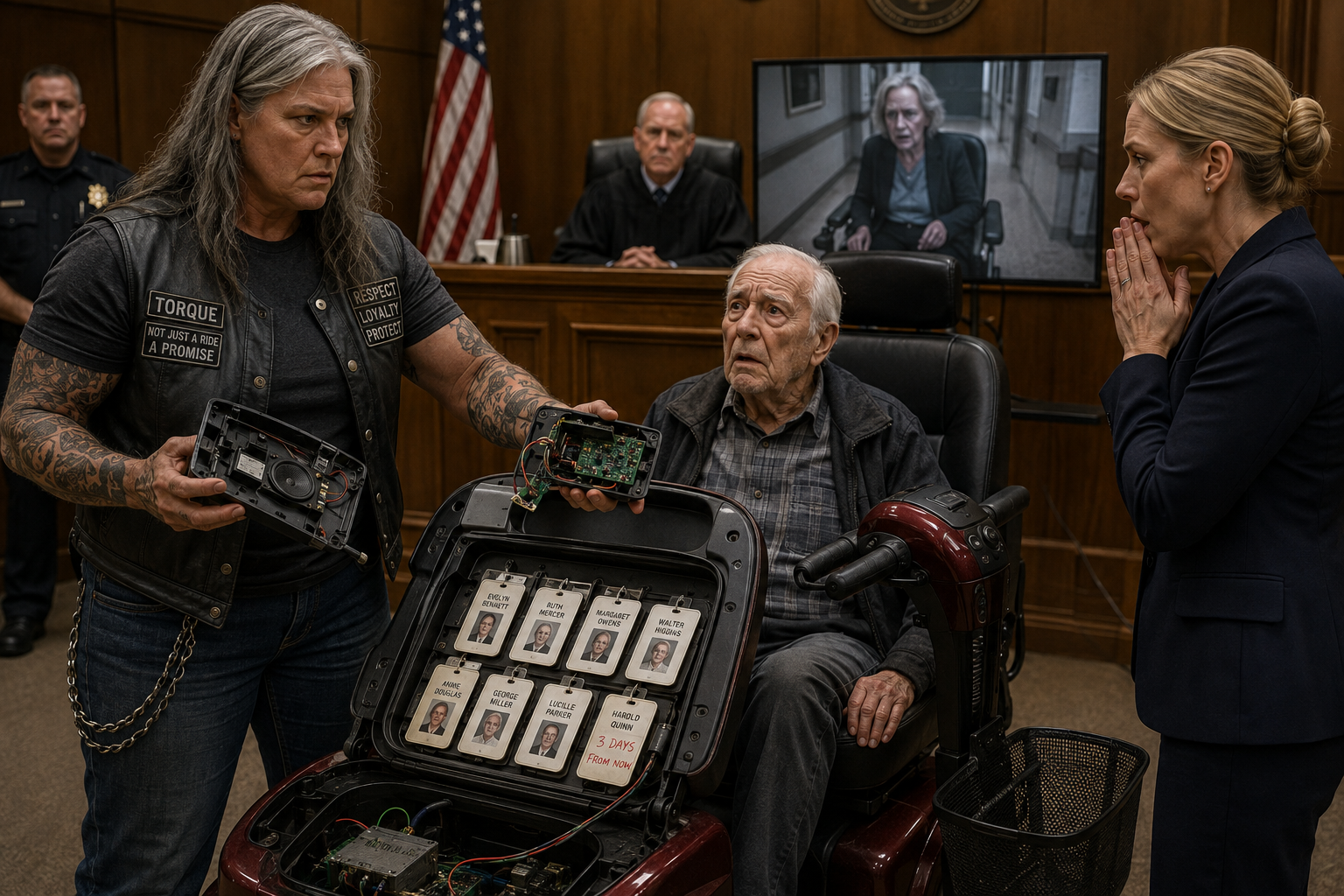
He had represented all seven residents whose identification tags lay across the evidence table.
When the deputy stopped him at the gallery doors, Pryce did not struggle. He placed the phone on a bench and said the camera feed was part of a safety service.
The technician opened the application.
It contained live video from Harold’s scooter, access to the hidden motor controller, and a folder labelled with the date printed on Harold’s eighth tag.
Three days from now.
Inside was a completed emergency guardianship petition claiming Harold had wandered into traffic, assaulted a caregiver, and become unable to manage his finances. The supporting incident reports were already signed.
None of the incidents had happened.
A separate document authorised Briarwood to move Harold into a locked memory-care unit after the hearing. His house would then be sold to cover the cost of treatment.
Darla looked at Celia Ward.
“You weren’t waiting for him to decline.”
Ward stared at the floor.
“You were manufacturing it.”
The judge suspended the guardianship hearing and placed Harold under temporary protection through an independent county advocate. Officers removed Pryce and Ward separately.
The investigation widened over the following weeks.
Briarwood staff had been giving selected residents sedatives, then activating hidden controls in their scooters and power chairs. The staged wandering incidents created the evidence needed to declare them incompetent.
Pryce received control of their assets.
Ward’s facility received their care payments.
The residents lost their homes, accounts, and the right to decide where they lived.
Evelyn Bennett had been one of the first.
Her chair had carried her through an unlocked service gate after medication left her barely conscious. When she tried to explain what happened, staff recorded her fear as paranoia.
Darla found the final audio file months later.
Her mother’s voice was weak but clear.
“If my daughter hears this, tell her I knew she kept coming.”
Darla listened once.
Then she turned the recording off and sat alone in her workshop until morning.
Ward and Pryce were eventually convicted of fraud, elder exploitation, unlawful surveillance, and conspiracy. Several employees testified in exchange for reduced charges. Briarwood closed, and every former resident received an independent review of their guardianship and finances.
Not everything could be returned.
Two houses had been demolished.
Some money had vanished.
Three residents had died believing their families abandoned them.
Harold kept his house.
He replaced the modified scooter with a plain manual chair that Darla inspected herself. She removed every panel, checked every wire, and made him watch while she did it.
“No hidden parts,” she said.
Harold smiled.
“You say that like a promise.”
“It is.”
He did not ask her to become his guardian.
After what had happened, neither of them trusted that word easily.
Instead, he named his niece as power of attorney, hired an independent advocate, and gave Darla permission to speak only when he asked.
She visited on Thursdays.
Sometimes they repaired radios at his kitchen table. Sometimes Harold told stories about Evelyn before Darla was born. Sometimes they said nothing.
A year later, Darla restored her mother’s identification tag and mounted it beside the dismantled receiver from Harold’s scooter.
She left the metal scratched.
The damage mattered.
Beneath them, she fixed a small brass plate bearing a single sentence:
She was not confused.
Harold stood beside her when she hung it.
For fourteen years, Darla had believed she failed to hear her mother.
The truth was that Evelyn had spoken clearly.
The wrong people had controlled who was allowed to listen.