
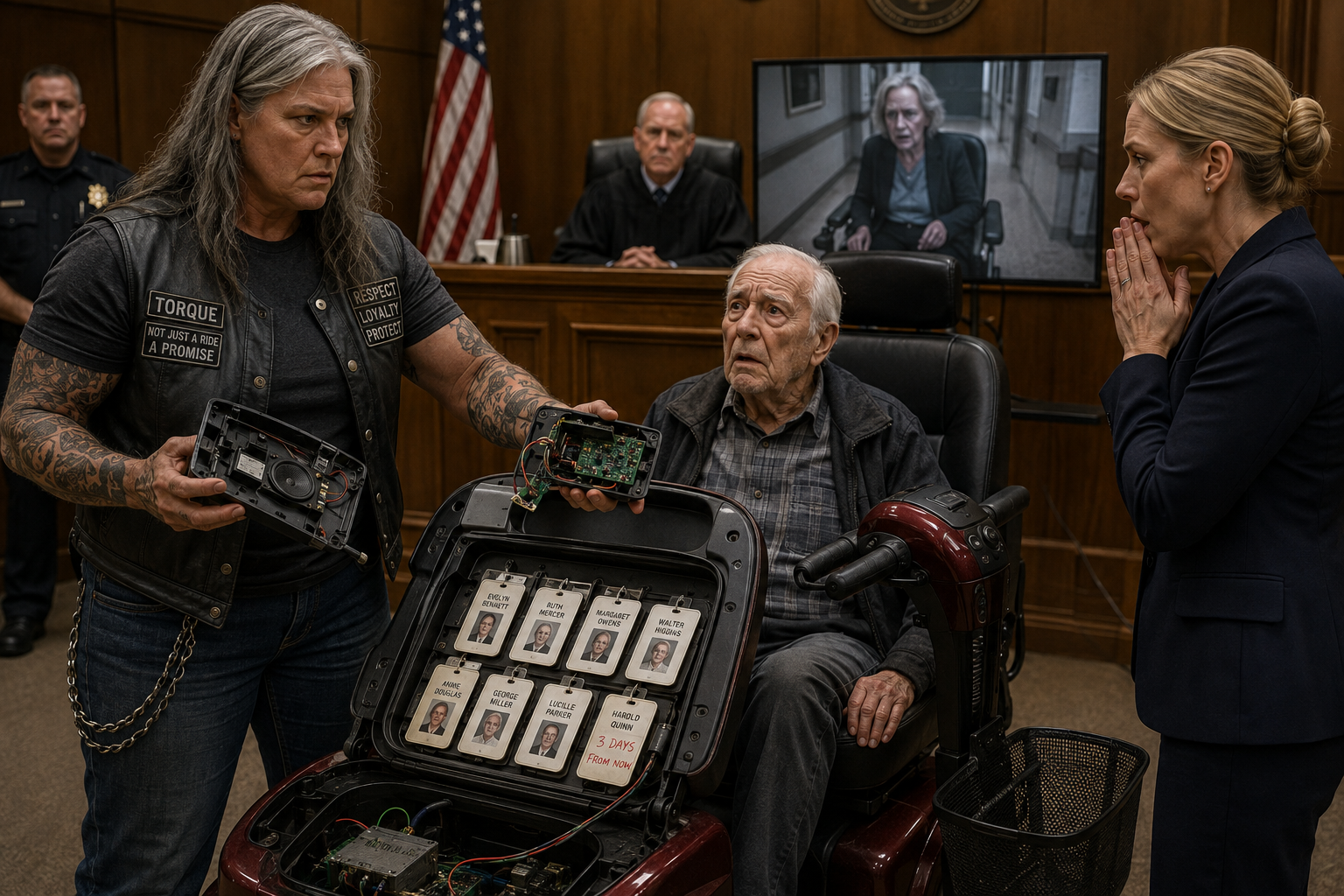
The judge asked whose name appeared on the tag.
Darla held it beneath the courtroom light.
“Evelyn Bennett.”
Her own voice sounded distant.
Harold looked from the tag to her face.
“Your mother lived at Briarwood?”
“For six months.”
The assisted-living director, Celia Ward, began gathering her papers.
“Those tags are old inventory. They prove nothing.”
The judge told her to sit down.
Darla remembered the final weeks of her mother’s life in pieces: unanswered calls, bruises explained as falls, staff insisting Evelyn had become confused and aggressive. One evening, police found her mobility chair beside a drainage ditch two streets from the facility.
Evelyn was lying in the grass.
She died in hospital three days later.
Darla had believed she wandered there herself.
She had apologised at the funeral for not believing how frightened her mother sounded on the phone.
The hidden receiver inside Harold’s scooter clicked again.
The live voice returned.
“Celia, disconnect the battery.”
The judge looked at Ward.
“You know that person?”
Ward said nothing.
A courthouse technician unplugged the scooter’s receiver from the second circuit board. The wheels stopped twitching.
Darla removed a small memory module from beneath the wiring. It contained dated command logs, each matched to a resident identification number.
Harold’s scooter had been remotely activated six times.
Every trip began within an hour of his evening medication.
Each ended outside the facility’s secure boundary.
The seven tags belonged to residents whose guardianship cases had followed the same pattern: sudden wandering, confusion documented by staff, emergency court petitions, then permanent control transferred to Briarwood’s contracted guardian.
Three had lost access to their bank accounts.
Two had sold their homes.
One had died before her appeal was heard.
The oldest file belonged to Evelyn Bennett.
Darla sat down without meaning to.
Harold touched her shoulder.
The gesture was light and uncertain, but it kept her from folding completely.
The judge ordered Ward’s phone and laptop seized. The deputy found a remote-control application still open on the phone. A list of resident names appeared beside battery levels and location indicators.
Ward claimed the system had been installed to recover lost residents.
“Then why hide it?” the judge asked.
Ward looked toward Harold.
“He was becoming dangerous.”
Harold’s face changed.
“I was dangerous to whom?”
No one answered.
The courthouse technician accessed the memory module without connecting it to the internet. Most files were command records, but one contained audio captured through the scooter’s hidden speaker.
A woman was crying.
Darla recognised her mother before the second sentence.
“The chair keeps moving after they give me the white pills.”
A man told Evelyn she was confused.
She insisted she had removed the key.
The man answered, “Then we’ll document another episode.”
Darla covered her mouth.
For fourteen years, she had carried shame that belonged to someone else.
The recording continued.
Evelyn said her daughter repaired engines and would understand the wiring.
The man laughed.
“Your daughter stopped visiting.”
Darla closed her eyes.
She had not stopped.
Briarwood had told her Evelyn no longer wanted contact.
The deputy received a message from officers searching the facility. They had located a locked maintenance room containing modified controllers, spare tracking units, medication logs, and copies of guardianship petitions prepared before several residents’ alleged wandering incidents occurred.
Celia Ward finally asked for an attorney.
Then Harold leaned toward the dismantled scooter.
A faint green light still blinked inside the battery compartment.
Darla had disconnected the receiver.
Something else remained active.
She pulled the battery tray forward and found a second transmitter attached beneath it, newer than the first and linked to a small sealed camera.
The courthouse technician checked its signal.
“It’s broadcasting live.”
“To where?” the judge asked.
He traced the connection, then looked toward the courtroom’s public gallery.
One phone in the back row was receiving the feed.
The man holding it stood and moved toward the exit.
Harold stared at him.
“That’s my court-appointed guardian.”
Darla looked at the seven identification tags spread across the evidence table.
Her mother’s was not the oldest anymore.
There was an eighth tag beneath the battery tray.
It carried Harold’s name and a date three days in the future.