
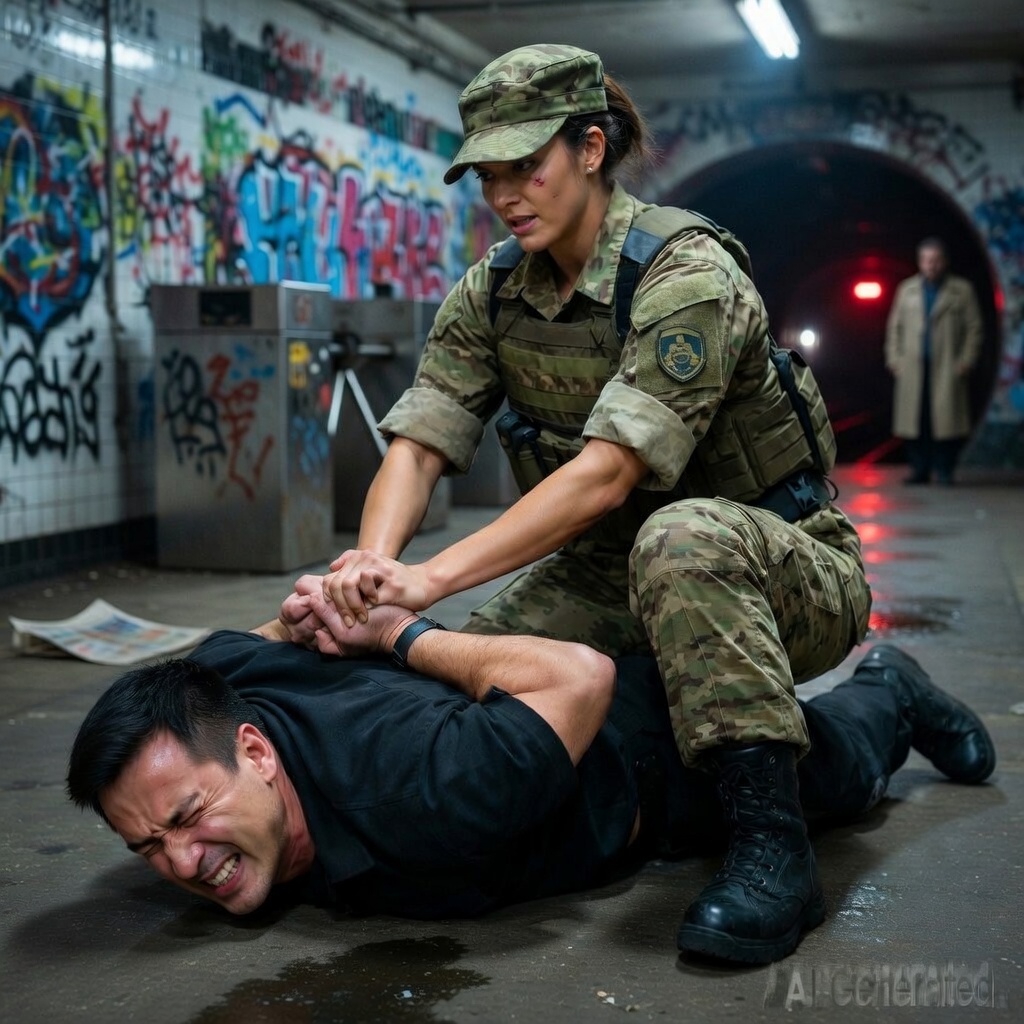
Claire had been a communications specialist, twenty-four years old, excellent evaluations, no disciplinary record. After accusing Mercer of sexual assault, she was ordered into psychiatric review. Her complaint was reclassified as evidence of distress and paranoia. Within months, she was discharged. Three weeks later, she was dead by suicide.
Elena sat motionless, her thumb pressed against the corner of Claire’s final statement. It was calm, detailed, and impossible to mistake for fantasy. She had told the truth. The system had answered by erasing her.
The next morning, Elena was formally notified that she was under investigation for excessive force during a training exercise. She was advised not to discuss the incident, not to contact witnesses, and not to interfere with command procedure. The message was clear: defend yourself and stay in your lane.
Instead, Elena began documenting everything.
She secured copies of the training yard camera footage before it could be altered. She contacted two legal advocates off base. She interviewed former personnel named in Vale’s files. Some refused to speak. Some were terrified. But a few, after years of silence, finally agreed to go on record. With each conversation, the story widened. Mercer was not an isolated predator. He was the visible blade of a protected machine.
Then came the warning.
A plain envelope was slid under Elena’s temporary quarters late one evening. Inside was a photograph of her younger sister leaving work in San Diego. On the back, in block letters, were five words: Let this die with you.
That should have ended it. For many people, it would have. But Elena had already crossed the point where fear could restore order. She turned the threat over to an outside investigator and pushed harder.
Within weeks, the inquiry into her conduct began to look less like discipline and more like retaliation. Reporters caught wind of sealed complaints. A congressional staffer contacted one of the women in Vale’s files. Then another. What had started as a broken knee on a training mat was becoming a chain reaction no colonel could fully contain.
Still, one question remained unanswered. Elena had evidence of victims, of cover-ups, even of intimidation. But to destroy Mercer and Royce, she needed proof that the command structure itself had knowingly buried crimes.
And buried deep in a defense archive was a recording someone had spent years making sure no one would ever see.
Part 3
The hearing room in Washington was colder than Elena expected. Not physically cold, but controlled, polished, stripped of emotion by design. Senators sat behind elevated desks. Military counsel lined the walls. Reporters filled every available seat. The room had the formal silence of a place built to decide which truths would matter and which would be buried again.
Elena Cross entered in full uniform, her posture rigid, her expression unreadable. Across the room sat Cole Mercer in a dark suit, one leg still stiff from the injury he had never forgiven. Beside him was Colonel Nathan Royce, composed as ever, the face of institutional confidence. For years, men like Royce had relied on the same assumption: that rank outlasted outrage, and that victims eventually got tired.
They had misjudged Elena.
Her testimony began with the incident at Camp Harlan. She described the demonstration, Mercer’s deliberate violation of training protocol, and the split-second decision that prevented serious injury to herself. The footage from the yard was then played in full. Slow motion removed every excuse. Mercer’s kick was not controlled. It was not accidental. It was a violent attack. The room watched him transform, frame by frame, from decorated soldier into aggressor.
Then Elena shifted the ground beneath everyone.
She introduced the files Thomas Vale had preserved, the sworn declarations from nineteen women, the psychiatric manipulations, the destroyed chains of evidence, and the career reprisals that followed complaint after complaint. Some senators leaned forward. Others looked down as if ashamed to meet the weight of the facts in public. Claire Donovan’s statement was read aloud into the record. For the first time, Claire’s words were not filtered through command, rumor, or diagnosis. They were heard exactly as she wrote them.
Mercer’s attorney argued that old allegations were unreliable. Royce’s counsel insisted the chain of command had acted within policy. That was when Elena’s legal team introduced the archive recording.
Years earlier, a logistics officer had quietly preserved a briefing after being ordered to delete it. The video showed Royce in a closed-door meeting discussing “containment,” “career risk,” and “the general’s concerns.” Mercer’s name was mentioned directly. So was the need to discredit at least one complainant psychologically before “the others got ideas.” Royce had not merely mishandled complaints. He had coordinated suppression.
The room broke open.
Mercer lost control first. He lunged verbally, calling Elena a liar, then spiraled into threats so reckless that even his own counsel stopped trying to calm the optics and simply told him to be silent. Royce tried a different strategy, the old polished one, but the recording had already gutted it. The senators did not need to infer intent anymore. They had heard it.
The investigation expanded beyond the hearing. Federal prosecutors moved in. Former staff who had once hidden behind procedure began cooperating to save themselves. Paper trails were recovered. Transfer orders, sealed recommendations, medical manipulations, and deleted communications were reconstructed with the help of outside investigators. One by one, the architecture of protection collapsed.
Mercer was convicted in federal court and sentenced to fifteen years in prison. His awards were stripped. His public image, once carefully protected by rank and influence, was reduced to the truth that should have followed him from the start. Royce was court-martialed, convicted for obstruction and abuse of authority, and sentenced to prison as well. Major General Mercer retired under scrutiny, his legacy permanently marked by the system he had helped shield.
But the most important outcome did not fit neatly into a sentencing summary.
The case forced a national reckoning over how harassment and assault complaints were handled inside military command structures. Reform advocates used the hearings, evidence, and survivor testimony to press for structural change. Over the years that followed, new review mechanisms were established, direct command influence over certain cases was reduced, and a generation of service members entered with at least a stronger chance of being heard than the one before them.
Thomas Vale attended the final public statement but stayed in the back. He never tried to claim credit. Elena found him afterward near the courthouse steps. He only said, “You did what the rest of us should’ve done sooner.” Elena answered honestly: “No. I just didn’t stop.”
Years later, now Lieutenant Colonel Cross, Elena stood on the grounds of the Naval Academy and watched her daughter, Julia, straighten the collar of a fresh uniform before orientation. Julia looked young, determined, and fully aware of the story attached to their family name. “Do you think it’s better now?” she asked.
Elena did not give her a false promise. “Better than it was,” she said. “Not better by accident.”
Julia nodded, understanding exactly what that meant.
As the ceremony crowd moved forward, Elena saw something she had not seen at Camp Harlan in 2003: not perfection, not safety guaranteed, but the visible possibility of fairness earned through painful effort. Claire Donovan never got that future. Neither did many others. But because their stories were finally forced into daylight, the system could no longer pretend silence was order.
That was Elena’s real victory. Not the broken knee. Not the headlines. Not the convictions.
It was this: the next woman who spoke up might no longer have to stand alone.