
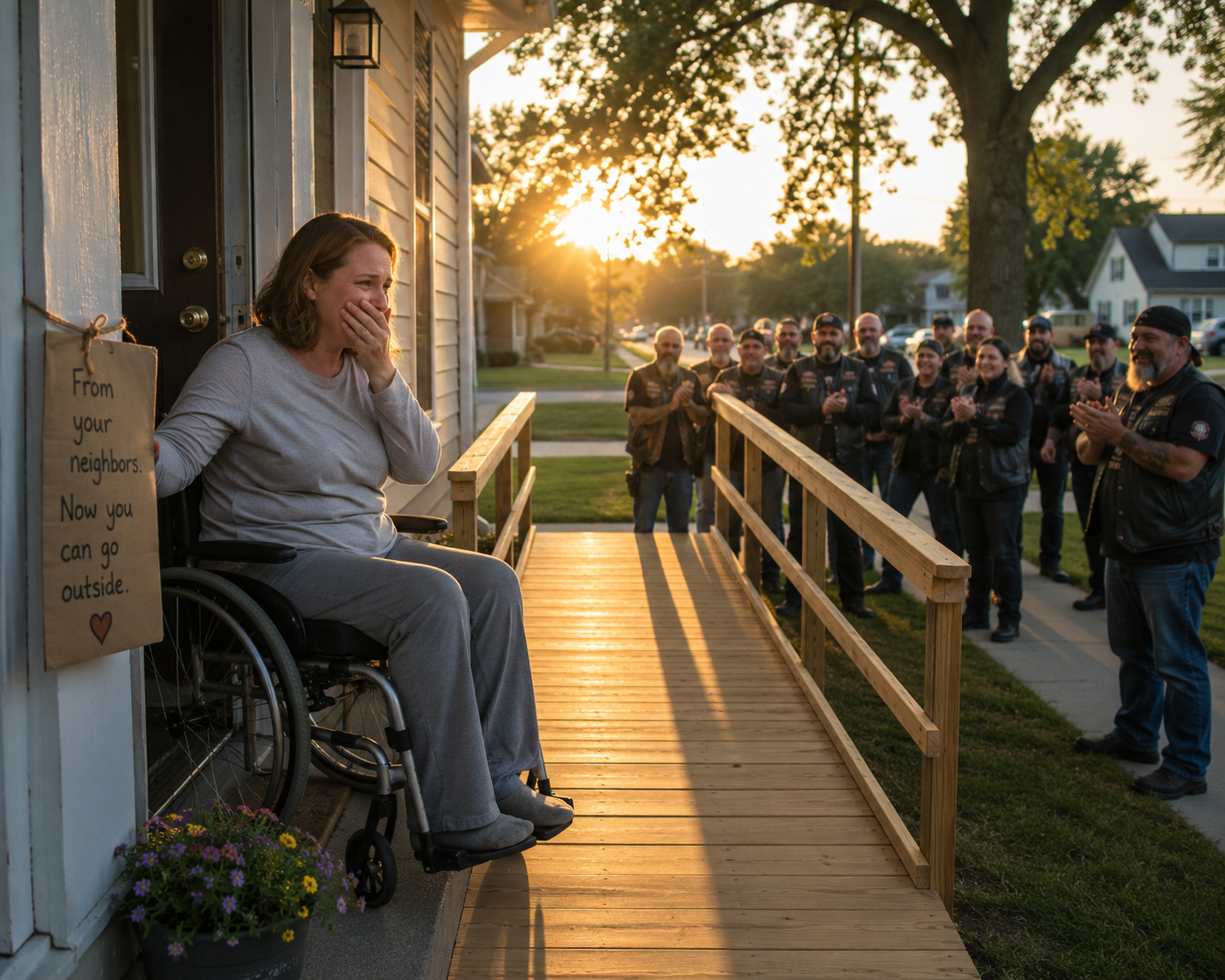
THE RAMP BUILT BEFORE DAWN
Part Two
Nobody removed the ramp by noon.
The county inspector’s name was Aaron Pike.
He had arrived expecting an illegal structure and an angry homeowner. Instead, he found a woman in a wheelchair holding paperwork that said she no longer owned the house she had paid for over fourteen years.
Walter Boone stood behind her.
Twenty-nine members of the Ashland Saints stood across the lawn.
None of them threatened Aaron.
That made him more willing to listen.
Evelyn Shaw, the retired building inspector who had supervised the overnight construction, took his clipboard.
She reviewed the dimensions.
Then she walked the entire ramp with a measuring tape.
“Maximum slope is compliant,” she said. “Landings are correct. Handrail height is correct. Anchoring meets residential code.”
Aaron looked at the structure.
“There was no permit.”
“Permit office opens at eight.”
“You began before midnight.”
“We began preparing lumber before midnight.”
Walter folded his arms.
“The ramp touched the house at twelve-oh-three.”
Aaron stared at him.
Walter stared back.
Evelyn returned the clipboard.
“You can issue a paperwork violation. You cannot call this unsafe.”
Aaron looked toward Julia.
She had gone pale.
The ownership document rested across her knees.
“I am not ordering demolition today,” he said.
The riders relaxed slightly.
“But the registered owner has requested removal. That creates a separate property dispute.”
Julia looked at the signature on the transfer.
“That is my name.”
“Did you sign it?”
“I don’t know.”
Walter frowned.
“How can you not know?”
Julia looked down at her legs.
“The first two weeks after surgery, I signed anything people put in front of me.”
Insurance releases.
Treatment approvals.
Rehabilitation forms.
Medical transport agreements.
Temporary power of attorney.
Her brother had managed most of it while she was medicated.
Aaron gave her a copy.
“You need an attorney.”
“I need my house.”
“For the moment, you still occupy it.”
“For the moment?”
“I can delay enforcement for forty-eight hours while ownership is challenged.”
Walter stepped forward.
“And after that?”
Aaron glanced at the riders.
“That depends on whether anyone here makes my job more difficult.”
Walter raised both hands.
“Wouldn’t dream of it.”
Aaron looked at the thirty motorcycles parked down the block.
“I find that difficult to believe.”
He left without marking the ramp for removal.
Julia did not celebrate.
She rolled back toward the house.
Halfway up the ramp, she stopped.
Her hands rested on the wheels.
“Walter.”
“Yes?”
“Did Nathan know you were building this?”
“He knew we wanted to help.”
“Did he tell you the house had been transferred?”
“No.”
“Did he pay for any materials?”
“No.”
“What exactly did he give you?”
“Your chair width. Porch measurements. A copy of the property survey.”
Julia turned around.
“A property survey?”
Walter’s expression changed.
“He said it would help with the permit.”
“When did he send it?”
“Three days ago.”
The day ownership changed.
Julia pulled out her phone.
Nathan did not answer.
She called again.
Voicemail.
A third time.
Nothing.
At 10:18 a.m., his truck appeared at the end of the street.
Nathan Mercer was forty-four, with the same dark eyes as Julia and the permanent exhaustion of a man who believed rest was something other families could afford.
He parked badly.
Got out before turning off the engine.
Then saw the ramp.
For one second, he smiled.
It vanished when he noticed the county notice in Julia’s hands.
“What happened?”
She held up the ownership document.
“You tell me.”
Nathan stopped at the bottom of the ramp.
Walter remained near the railing.
Not blocking him.
Close enough to make clear that Julia would not face the conversation alone.
Nathan read the page.
His face changed.
“Where did you get this?”
“The county.”
“This isn’t supposed to be final.”
Julia stared at him.
“So you knew.”
“I knew about the company.”
“You created it.”
“To protect the house.”
“From whom?”
“The hospital.”
Julia’s hands tightened around the paper.
“What did you do?”
Nathan looked at the neighbors.
“This is private.”
Julia answered:
“My ownership became public record yesterday. We are past private.”
He lowered his voice.
“The hospital bills are larger than you think.”
“I know exactly how large they are.”
“No, you know what insurance lists online. There are rehabilitation costs, transport fees and equipment claims still under review.”
“So you transferred my house?”
“I moved it into a holding company.”
“Without telling me.”
“You signed a durable power of attorney.”
“I signed it so you could pay utilities while I was unconscious.”
“And to protect your assets.”
“Not from me.”
Nathan flinched.
Walter looked away.
Julia continued:
“Why is Mercer Residential Holdings ordering my ramp removed?”
“It isn’t.”
She handed him the notice.
Nathan read it twice.
Then took out his phone.
He called someone named Grant.
No answer.
He called again.
“Who is Grant?” Julia asked.
“The financial adviser who arranged the transfer.”
“What financial adviser?”
“A man from Ridgeway Community Assistance.”
Walter’s head lifted.
“Ridgeway?”
Nathan nodded.
The name meant nothing to me.
It meant something to Julia.
Her face went still.
“The van.”
Nathan looked at her.
“What?”
“The van that hit me belonged to Ridgeway Construction.”
Silence moved through the yard.
Nathan shook his head.
“Different company.”
“Are you sure?”
“Yes.”
“How?”
“He told me.”
Walter muttered something beneath his breath.
Julia held out one hand.
“Show me every document.”
Nathan went to his truck.
He returned with a folder thick enough to prove he had been hiding more than one decision.
Inside were loan applications, ownership forms and an agreement titled:
EMERGENCY RESIDENTIAL PRESERVATION PROGRAM
Ridgeway Community Assistance had offered to place Julia’s home into a limited-liability company to shield it from medical creditors.
In return, the program would provide a low-interest loan for accessibility modifications.
A ramp.
Wider doors.
Bathroom renovation.
Nathan had signed as Julia’s representative.
The loan was for $62,000.
Julia had never received a dollar.
Evelyn read the agreement at my dining-room table while Walter called a lawyer he knew through the Ashland Saints.
Thirty minutes later, attorney Rebecca Sloan arrived.
She used a cane.
She had spent twelve years handling housing fraud and disability-access cases.
Rebecca reviewed the contract.
Then pointed to a paragraph on page seventeen.
“If the property fails inspection within thirty days of transfer, management control passes to the program administrator.”
Nathan leaned closer.
“What inspection?”
“Structural-accessibility inspection.”
“The house obviously failed. That’s why we needed the loan.”
“Exactly.”
Julia looked at him.
“They designed the loan to default immediately.”
Rebecca nodded.
“The company became controlling manager three days ago.”
“Who owns the company?”
“On paper, Nathan is director.”
“I don’t control anything,” he said.
“You hold twenty percent voting authority.”
“What about the rest?”
Rebecca turned the page.
“Eighty percent belongs to Ridgeway Neighborhood Renewal Fund.”
Julia closed her eyes.
The company connected to her accident had gained control of her home while she was recovering from the injuries caused by its van.
Nathan pressed both palms against the table.
“I thought I was protecting her.”
Rebecca’s voice was clinical.
“You were targeted because you were frightened and exhausted.”
“That doesn’t make me less responsible.”
“No.”
Julia looked at him.
“It doesn’t.”
Nathan did not defend himself.
That may have been the only reason she allowed him to remain in the room.
Rebecca began tracing the companies.
Ridgeway Construction.
Ridgeway Community Assistance.
Ridgeway Neighborhood Renewal Fund.
Different names.
Same registered office.
Same attorney.
Same controlling family.
“They have purchased eleven properties within six blocks,” Rebecca said.
I looked toward Julia’s house.
“Why?”
Walter answered.
“The old rail depot.”
A commercial redevelopment had been proposed near the river.
Warehouses.
Truck access.
Distribution buildings.
Julia’s street stood between the planned depot and the main road.
Most homeowners had refused early offers.
Then properties began changing hands.
One owner entered assisted living.
Another faced foreclosure.
A third sold after a kitchen fire.
Rebecca studied the documents.
“This is not a charity program. It is an acquisition system.”
Julia looked toward the ramp through my window.
“They were waiting for me to become desperate.”
Nathan shook his head.
“They contacted me at the rehabilitation center.”
“Who gave them your name?”
“My case coordinator.”
Rebecca wrote it down.
“Name?”
“Melissa Grant.”
“Related to the adviser?”
“He said she was his sister.”
Rebecca stopped writing.
“Your adviser’s full name?”
“Grant Wallace.”
There was no Grant in his name.
It was the surname he wanted Nathan to remember.
A hospital records check showed no employee named Melissa Grant.
The woman had visited Nathan wearing a rehabilitation-services badge.
Security footage showed her entering with representatives from Ridgeway’s insurance company.
The accident claim and the housing transfer had never been separate.
By late afternoon, Rebecca filed an emergency petition challenging the deed and requesting an injunction against eviction or alteration of the property.
Aaron Pike approved a temporary ramp permit after reviewing Evelyn’s plans.
For the first time that day, Julia allowed herself to roll outside again.
She reached the bottom.
Then looked at Nathan.
“Did you really think I should leave this house?”
He stared at the pavement.
“I thought you might need somewhere easier.”
“That is not an answer.”
He looked up.
“Yes.”
Her face tightened.
“I thought a single-level apartment near rehabilitation would be safer.”
“For whom?”
“You were trapped.”
“So you sold the trap instead of opening the door.”
Nathan had nothing to say.
Julia rolled past him.
Walter followed at a respectful distance.
They reached the corner before Julia stopped.
The coffee shop was two blocks away.
She had not been there since the accident.
“You tired?” Walter asked.
“Yes.”
“Want to go back?”
“No.”
He nodded.
“Good answer.”
It took them forty minutes to travel two blocks.
At the café, strangers held the door.
Julia hated that.
Then accepted it.
She ordered the same cinnamon coffee she used to buy before work.
The world had not become easy.
It had become reachable.
When we returned, Rebecca was standing on the porch with Detective James Keller from the county fraud unit.
Nathan’s truck door was open.
His folder was gone.
“So is Nathan,” Rebecca said.
Julia looked around.
“He was here ten minutes ago.”
Detective Keller held up a phone.
Nathan’s phone.
It had been found beside the side gate.
On the screen was an unfinished message to Julia:
I found the original inspection report. The house passed before your accident. They changed the date because—
The message ended there.
Walter walked toward the ramp.
He crouched beside the lower support post.
Fresh sawdust lay beneath it.
Someone had cut halfway through the main brace.
If Julia had descended alone again, the lower section might have collapsed beneath her.
Detective Keller ordered everyone away from the structure.
Then my doorbell camera alert sounded.
The recording showed Nathan walking toward his truck fifteen minutes earlier.
A white construction van stopped beside him.
The side door opened.
A woman wearing a rehabilitation-services badge stepped out.
Nathan recognized her.
He backed away.
Two men pulled him into the van.
Before the vehicle left, the woman turned toward my camera.
It was the same woman from the hospital footage.
The false case coordinator.
The van’s Ridgeway logo had been covered, but not completely.
Beneath the temporary white paint, a blue letter remained visible.
Julia stared at it.
Then whispered:
“That is the van that hit me.”
Detective Keller looked at her.
“You’re certain?”
“The dent above the rear wheel.”
She moved closer to the screen.
The original accident photographs showed the same damage.
The van had supposedly been destroyed after the crash.
Instead, it had just abducted her brother.
Rebecca opened the recovered file on Nathan’s phone.
One photograph had been taken before he disappeared.
It showed a Ridgeway inspection document dated two weeks before Julia’s accident.
Across the top was her address.
Below it:
PROPERTY ACQUISITION RESISTANCE: HIGH.
Attached was a photograph of Julia standing on her porch.
In the background, someone had marked the four concrete steps with a red circle.
At the bottom of the page, a handwritten note read:
Mobility event would significantly alter owner’s ability to remain.
Nobody spoke.
Julia looked from the note to the damaged ramp.
Then at the white van disappearing from my camera’s view.
Her accident had not made the house valuable to Ridgeway.
The house had made her accident valuable.