
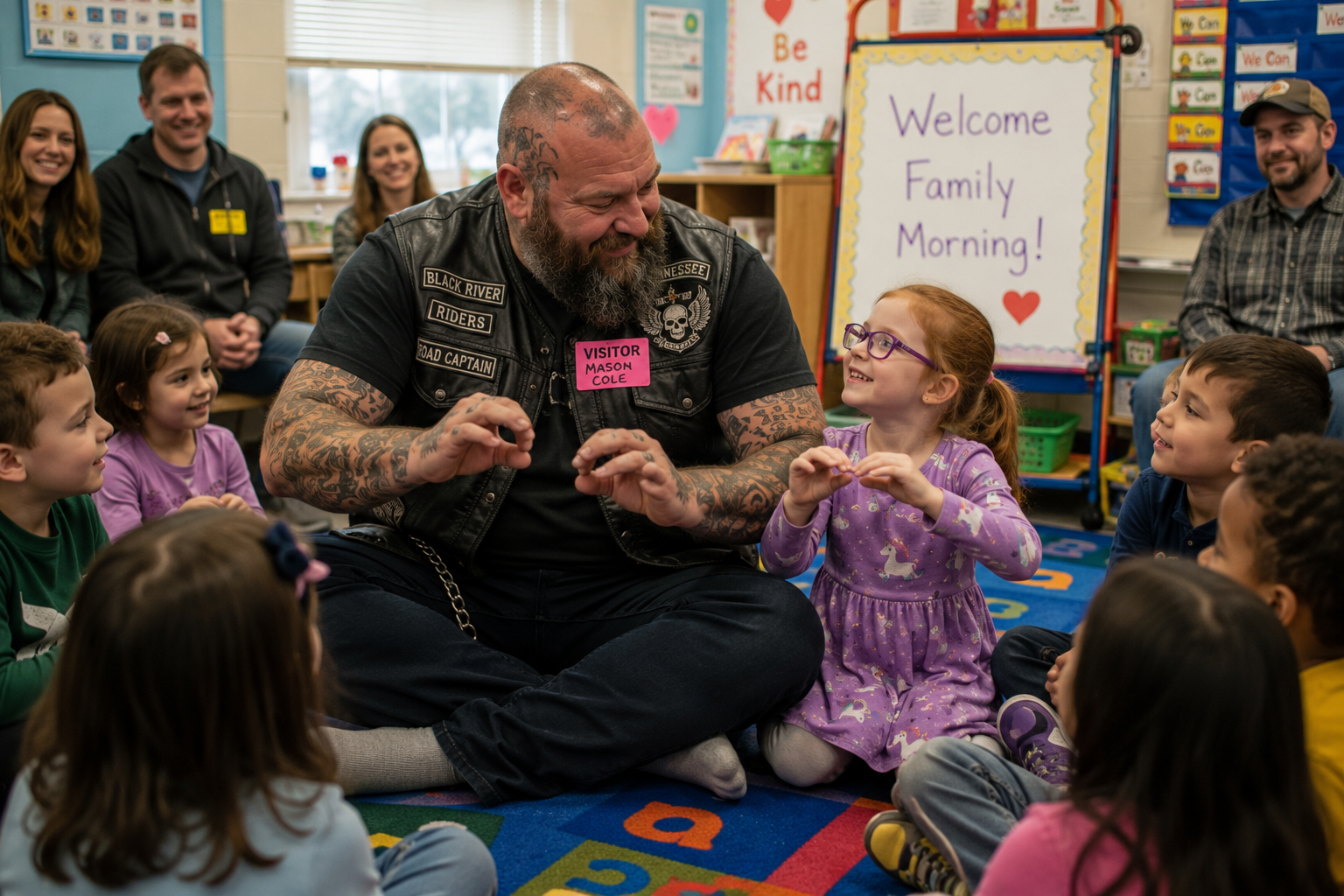
THE MAN ON THE KINDERGARTEN RUG
Part Three
The deputy shouted twice.
“Drop it!”
Dennis Crow did not.
The flare gun stayed pointed toward the rusted toolbox.
Lauren was tied to a metal chair ten feet behind him, one side of her face bruised, wrists red where plastic ties cut into the skin.
Bear stood just inside the service bay with both hands visible.
He had followed the deputies exactly as ordered.
No rushing.
No threats.
No fists.
That may have been the hardest thing he had ever done.
Dennis smiled at him.
“You still wear that ribbon.”
Bear’s face changed.
The pale blue strip inside his vest had slipped into view.
“Rosie’s ribbon.”
Dennis laughed.
“You still think that’s what it is?”
Bear stared.
“What are you talking about?”
Dennis lowered the flare gun slightly.
Not enough.
“That ribbon came off the evidence box.”
Lauren closed her eyes.
Bear went still.
“My brother’s box?”
“Yes.”
The deputy said:
“Dennis, put the weapon down.”
He ignored him.
Bear looked at the toolbox.
“What did Tommy find?”
For the first time, Dennis looked nervous.
Thomas Hollis had been Bear’s older brother.
A mechanic.
A volunteer fire investigator.
Dead in a motorcycle crash one year before Rosie.
That was the official story.
Dennis said:
“Your brother found things he should’ve left alone.”
“What things?”
“Insurance fraud.”
Bear frowned.
Dennis continued.
“Tow yards billing wrecks that didn’t exist. Fire-damaged vehicles stripped before insurance inspection. Parts resold through salvage companies.”
Bear’s face hardened.
“You were involved.”
Dennis smiled faintly.
“Your brother thought he was going to clean up the county.”
“And you killed him.”
Lauren gasped.
Dennis shook his head.
“Tommy killed himself riding too fast.”
Bear took one step.
Two deputies raised their weapons.
“Wade.”
He stopped immediately.
Dennis saw that.
“You’ve changed.”
Bear’s voice was flat.
“My daughter needed me to.”
The sentence seemed to irritate Dennis more than anger would have.
“Tommy kept copies.”
He nodded toward the toolbox.
“Photographs. invoices. names. enough to put people away.”
“And Rosie found it?”
“Yes.”
“How?”
“Your brother hid it in your garage before he died.”
Bear’s eyes narrowed.
Dennis continued.
“Rosie liked hiding under workbenches.”
Bear closed his eyes.
He remembered.
Of course he remembered.
Six years old.
Always carrying chalk.
Drawing on pieces of scrap metal while he worked.
She had probably found the box by accident.
“What did she do?”
“Told Lauren.”
Lauren began crying.
“I didn’t understand what it was.”
Bear looked at her.
She forced herself to continue.
“Rosie brought me the ribbon first.”
“What ribbon?”
“The blue one.”
Her eyes moved to his vest.
“It was tied around the toolbox handle.”
Bear touched it.
All these years he had believed it came from Rosie’s hair.
Lauren had told him that after the fire.
Another lie.
Or perhaps another desperate attempt to make something unbearable survivable.
“Why did you tell me it was hers?”
Lauren whispered:
“Because I was ashamed.”
“Of what?”
“I called Dennis.”
Bear stared at her.
“You what?”
“I knew he worked fire investigations. I thought Tommy might have left something dangerous. I asked him to come look.”
Dennis smiled.
Bear’s face drained.
“You invited him into my house.”
Lauren nodded, sobbing.
“I didn’t know.”
“What happened?”
“Dennis came while you were working.”
She looked at the floor.
“Rosie showed him the box.”
Bear’s breathing changed.
“And?”
“He told me it was evidence from one of Tommy’s old cases. Said he needed to take it.”
“Did you let him?”
“At first.”
Lauren swallowed.
“Then Rosie said Uncle Tommy told her nobody was allowed to take it except you.”
Bear’s eyes filled.
“She remembered that?”
“Yes.”
Dennis’s smile disappeared.
Lauren continued.
“Rosie grabbed the box.”
My heart would later break when I heard the next part.
Because Rosie had been six.
Not a witness.
Not an investigator.
Just a child obeying one instruction from an uncle she loved.
“Dennis tried to take it from her.”
Bear whispered:
“No.”
“She ran to her room.”
The bedroom.
The locked door.
The missing smoke-alarm battery.
Bear stared at Dennis.
“You followed her.”
Dennis said nothing.
“You locked the door.”
Still nothing.
The deputy spoke.
“Dennis.”
His jaw tightened.
Then:
“I needed time.”
Bear looked as if he had stopped understanding language.
“You locked a six-year-old child in a room.”
“I wasn’t going to hurt her.”
Lauren screamed:
“You set the fire!”
Dennis snapped:
“I knocked over a fuel can!”
The confession hung in the building.
Every body camera caught it.
Every deputy heard it.
Dennis realized too late.
His face changed.
Bear whispered:
“You took the smoke-alarm battery.”
Dennis said nothing.
“You knew the fire would spread.”
“No.”
“You left her.”
“I panicked.”
Bear’s hands began shaking.
Not fists.
Just shaking.
The deputy closest to him said quietly:
“Stay with me, Wade.”
Bear stared at Dennis.
Then looked at Lauren.
“You were outside when I got there.”
She nodded.
“Why didn’t you tell me?”
“Because Dennis said he’d tell police I started it.”
“Why would they believe him?”
“I was high.”
That answer cut through everything.
Lauren’s addiction.
The pills.
Her missing memory.
Her unreliable timeline.
Dennis had chosen the perfect person to blame.
Just as everyone later chose Bear as the obvious dangerous man.
Lauren looked at him.
“He told me you’d kill him if you knew.”
Bear laughed once.
Empty.
“You should’ve trusted me with the truth.”
“I know.”
“No.”
He shook his head.
“You know now.”
Dennis raised the flare gun again.
“Enough.”
He pointed it toward the toolbox.
“If that burns, none of this matters.”
The deputy said:
“We already have your confession.”
Dennis looked toward the body camera.
He understood.
That was when panic replaced confidence.
He fired.
The flare crossed the service bay in a red arc.
Bear moved before anyone else.
Not toward Dennis.
Toward the toolbox.
He kicked a metal drain pan across the floor.
The flare struck it instead.
Sparks scattered.
A deputy tackled Dennis.
The flare gun slid away.
Another officer dragged the toolbox clear.
Bear did not touch Dennis.
Not once.
He went to Lauren.
The deputies cut her restraints.
She looked at Bear through tears.
“I’m sorry.”
He stared at her for a long time.
Then said:
“Save it for Sophie.”
That was all.
Inside the toolbox were Tommy Hollis’s records.
Insurance files.
Photographs.
Ledgers.
Copies of emails linking Dennis to years of salvage fraud.
And one cassette recording made days before Tommy died.
In it, Tommy said he believed someone had tampered with his motorcycle brake line.
The motorcycle was exhumed from an old evidence warehouse.
Forensic inspection found exactly that.
Dennis had not only caused Rosie’s death.
He had likely caused Tommy’s too.
The investigation expanded.
Several former salvage operators were charged.
Dennis Crow eventually faced charges tied to arson, kidnapping, evidence tampering, fraud, Rosie’s death and the death of Thomas Hollis.
Lauren cooperated.
She also faced consequences for choices she had made before and after the fire.
Bear never pretended addiction erased responsibility.
He also stopped pretending responsibility erased humanity.
That distinction mattered because of Sophie.
Three days after the towing-yard arrest, Bear sat in my classroom again.
No parents this time.
No Family Morning.
Just Sophie at a little table coloring.
Bear wore the black vest.
The blue ribbon still stitched inside.
Sophie looked up.
“Is Rosie’s mommy bad?”
Bear sat carefully in the tiny chair across from her.
“No.”
She frowned.
“Is she good?”
He thought.
“People aren’t usually only one thing.”
Sophie considered that.
“Did she lie?”
“Yes.”
“Did you?”
Bear looked at me.
Then back at his daughter.
“Yes.”
“About her being dead.”
“Yes.”
“Why?”
“Because I thought it would keep you safe.”
“Did it?”
Bear went silent.
Children have a cruel talent for reaching the exact place adults have been avoiding.
“Some.”
“That’s not yes.”
“No.”
Sophie nodded.
Then she pointed at the ribbon.
“Was that Rosie’s?”
Bear touched it.
“No.”
“Then why do you wear it?”
“Because Rosie touched it.”
He swallowed.
“And because I spent a long time believing it meant one thing.”
“What does it mean now?”
Bear looked toward the paper rainbow above the rug.
Then said:
“That she tried to protect something important even though she was little.”
Sophie considered that.
“She was brave.”
“Yeah.”
“Like me?”
Bear smiled.
“Different kind.”
She reached into her backpack.
Pulled out a new piece of ribbon.
Purple.
Cheap craft-store satin.
“What’s that?”
“For you.”
“Why?”
“Because blue is sad.”
Bear looked offended.
“I like blue.”
“I like purple.”
“That does sound like the deciding factor.”
She stood on the chair.
I moved closer in case she slipped.
Sophie tucked the purple ribbon into the inside of his vest beside the blue one.
“What does this mean?” Bear asked.
She thought.
Then:
“You came to school.”
His face changed.
That simple.
The ribbon did not represent a tragedy.
A death.
A crime.
Or something he had failed to prevent.
It represented a Thursday morning when he showed up.
Bare feet on a kindergarten rug.
Hole in one sock.
Singing badly.
Doing the motions because his daughter asked.
Bear’s eyes filled.
Sophie immediately frowned.
“Are you crying?”
“No.”
“You are.”
“Allergies.”
“In winter?”
“Very aggressive allergies.”
She laughed.
Months later, Lauren was permitted limited supervised contact with Sophie after extensive court review and treatment.
Bear hated the idea at first.
He also understood something he had not understood when Rosie died.
Protecting Sophie did not mean making every decision from fear.
It meant building rules.
Supervision.
Consent.
Boundaries.
And allowing Sophie’s needs to matter more than his anger.
The first meeting lasted twenty minutes.
Lauren cried.
Sophie did not.
She asked questions.
Why did you leave?
Did you know Rosie?
Why didn’t Daddy tell me?
Lauren answered what she could.
She did not ask Sophie to call her Mom.
That helped.
Bear waited outside.
Not because a court required it.
Because Sophie had asked.
When she came out, she took his hand.
“You stayed.”
“Course I did.”
“You didn’t go fight anybody?”
He looked deeply offended.
“I have hobbies.”
“What hobbies?”
Bear thought.
“Towing.”
“That’s your job.”
“Motorcycles.”
“That’s also your job.”
He frowned.
“Your questions are becoming hostile.”
She laughed all the way to the truck.
A year after Family Morning, Maple Grove held the event again.
Bear came early.
Still on the Harley.
Still terrifying half the new parents in the parking lot.
Still removing his boots before stepping on the classroom rug.
This time, when we sang “If You’re Happy and You Know It,” he knew every motion.
Sophie announced:
“My dad practiced.”
Bear said:
“False.”
“He practiced in the kitchen.”
“Defamation.”
The children laughed.
When he lifted his arms to clap, his vest opened.
The blue ribbon showed.
And beside it—
purple.
Principal Moore noticed.
She covered her mouth again.
But this time she was smiling.
People sometimes think redemption arrives through one enormous act.
It rarely does.
Most of the time it arrives as smaller decisions.
Not throwing the punch.
Taking the boots off.
Asking permission.
Listening when your child says no.
Showing up after you missed the last three things.
Telling the truth even when the lie was originally meant as protection.
Bear never became less intimidating.
He remained six-foot-four.
Tattooed.
Scarred.
Loud motorcycle.
Heavy boots.
A face that made strangers reconsider arguments.
What changed was not how he looked.
It was what people around Maple Grove learned to look for.
The way Sophie ran toward him.
The way he always crouched before hugging her.
The way he waited for permission before touching anyone else’s child.
The two ribbons hidden against his chest.
One for a daughter he could not save.
One for the daughter who taught him that being a good father was never about preventing every terrible thing.
Sometimes it was simply about being there when the song started—
and doing the motions.