
The first man laughed before the door even closed behind me.
The second one said I must have taken a wrong turn off the highway.
The third called me “Grandma” like it was an insult.

I stood in the doorway of the Iron Ridge Riders clubhouse with rain dripping from my coat, clutching a plastic grocery bag to my chest, and let them laugh.
At seventy-eight years old, you learn that laughter from foolish men is rarely worth answering.
My name is Martha Briggs.
Once, a long time ago, men tougher than the boys in that room had called me Marty and meant it with respect. But most of them were gone now. My husband, Raymond Briggs, had been gone twelve years.
The world knew him as Smoke.
Founder of the Iron Ridge Riders.
President.
Mechanic.
Troublemaker.
Brother.
But to me, he was the man who burned pancakes on Sunday mornings, sang off-key in the shower, and rubbed my hands at night when the sewing needle had left them swollen and sore.
That Tuesday would have been his eighty-second birthday.
I had spent the whole afternoon sitting alone in our little house outside Marietta, Ohio, staring at his photograph on the mantel. The rain tapped against the windows. The house smelled faintly of cedar, dust, and the lavender soap I still bought even though Ray had been the one who liked it.
At the foot of our bed sat an old cedar chest.
Inside, wrapped in tissue paper, was Ray’s first leather cut.
Not the polished one they displayed in club photos.
The first one.
Cracked black leather. Faded seams. A crooked inner pocket I had sewn badly and Ray had refused to let me fix because he said it made the thing honest.
I had stitched the first thirteen Iron Ridge patches at our kitchen table in 1984.
Thirteen.
The founding brothers.
Ray had come home with a drawing on a paper napkin and a dream too big for our rent money.
“No man rides alone,” he told me. “No widow gets forgotten. No kid of a brother goes hungry. That’s the whole idea.”
I believed him.
So I sewed.
Three nights straight.
The leather was thick as a Bible cover. The needle hated it. By the second night, my fingers bled. By the third, I had strips of dish towel wrapped around two fingertips and a pot of coffee strong enough to strip paint.
I still remember holding up Ray’s finished cut under the yellow kitchen light.
IRON RIDGE RIDERS across the top.
His road name underneath.
SMOKE.
Ray looked at it like I had handed him a kingdom.
That club grew from thirteen men drinking coffee in my kitchen to chapters across three states. They buried their dead. Raised money for burned-out families. Fixed roofs for widows. Paid hospital bills for men too proud to ask.
For forty years, that patch meant something.
Then Ray died.
Heart attack in his sleep.
The last thing he said to me was, “Don’t forget the tire pressure on the truck.”
That was my Ray.
Two hundred motorcycles followed him to the cemetery. I stood beside his grave and listened to engines rumble like thunder from another world.
After the funeral, I stopped going to the clubhouse.
Not because I was angry.
Because everywhere I looked, he was there.
At the bar he built.
In the chair he always leaned back too far in.
On the wall where his name was painted in gold.
I could not bear a room full of him without him in it.
Years passed.
The old brothers died, moved, or got too tired to ride. New men came in, young and loud, wearing the symbol my bloody fingers had helped create without knowing there had ever been a woman behind it.
Only one original remained.
Walt Tanner.
Whitey, everyone called him, because his hair had gone white before he was forty.
I had not seen him in years.
That night, I decided Ray’s first cut did not belong in my cedar chest anymore.
It belonged home.
So I folded it carefully, placed it in the only clean bag I had, and drove through the rain to the dead-end gravel road where the clubhouse still stood.
The neon sign buzzed blue through the window.
IRON RIDGE.
The roof was tin. The parking lot was mud. The sound of pool balls and men laughing leaked through the walls.
I almost turned around.
Then I thought of Ray.
You finish what you start, Marty.
So I opened the door.
The room smelled of beer, cigarette ghosts, engine oil, and wet leather. Maybe twenty men were inside. Most were young. Most looked at me like I was furniture that had wandered in by mistake.
One of them was louder than the rest.
He stood from a barstool with a beer in one hand and confidence in the other.
His name patch read DIESEL.
He could not have been older than twenty-six.
“You lost, sweetheart?” he asked, grinning. “Senior bingo is two towns over.”
Laughter rolled across the room.
I said, “I came to leave something.”
I tried to step toward the bar.
He moved in front of me.
“What you got in the bag? Medication? Cat food?”
“Please let me pass.”
He flicked the plastic bag with one finger.
“Come on, Granny. Share with the class.”
Behind the bar, an old man rinsing a glass finally looked up.
Whitey.
I recognized the white hair before the face.
But Diesel had already reached out.
He took the bag right out of my hands.
“Please,” I said, and hated how small my voice sounded. “Give that back.”
He lifted it over his head while the younger men laughed.
A few older ones stopped smiling.
Not one stood.
That hurt more than the laughter.
Diesel shook the bag, expecting a scarf or pills or something foolish.
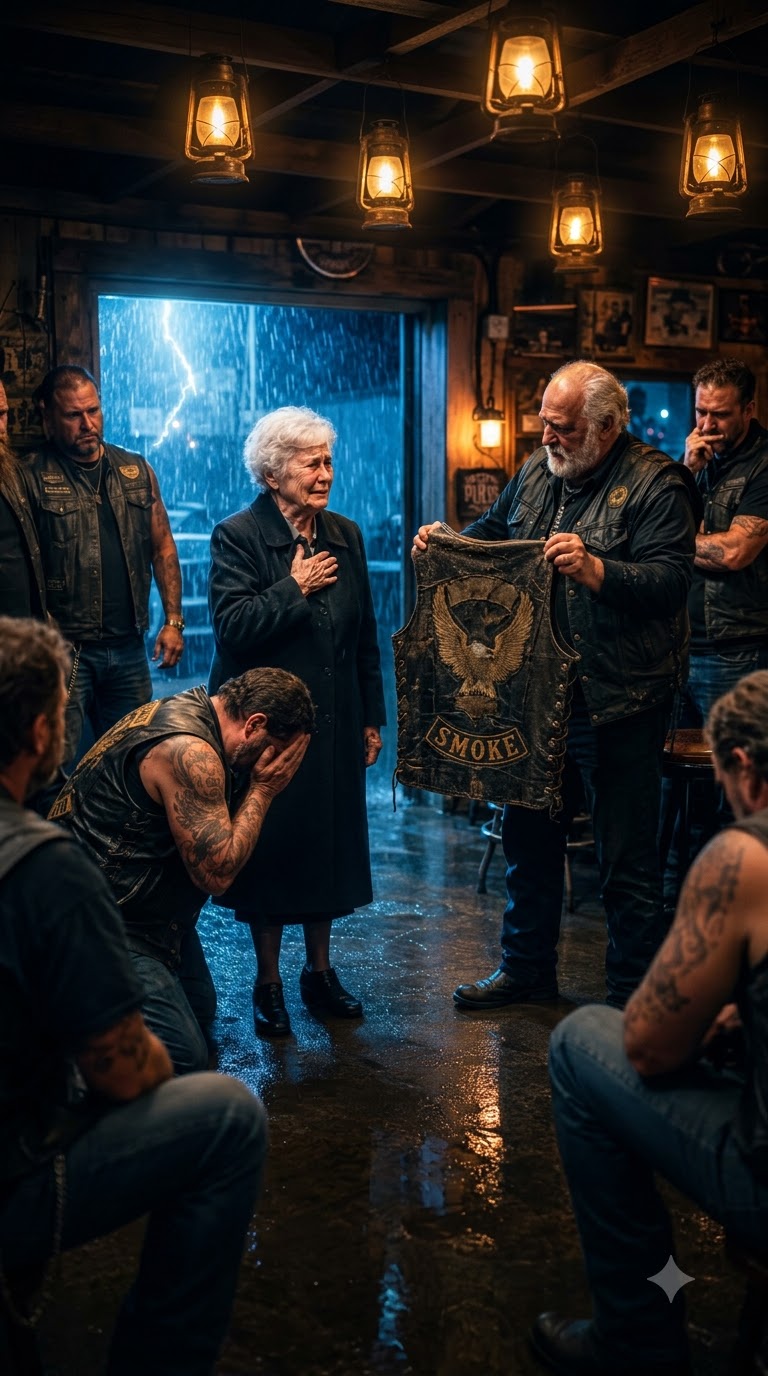
Instead, Ray’s old leather cut slid out into his hand.
The room went quiet in pieces.
First the bar.
Then the pool table.
Then the booths.
The jukebox kept playing, ridiculous and cheerful, while every eye fixed on the cracked black leather hanging from that young man’s fist.
Diesel stared at the back patch.
Then up at the gold name painted six feet wide over the bar.
SMOKE.
His grin disappeared.
Whitey came out from behind the bar faster than his bad hip should have allowed. He took the cut from Diesel’s hand like it was a wounded child.
Then he looked at me.
His old face broke open.
“Marty?” he whispered. “Martha Briggs?”
Forty years fell between us and vanished.
“Hello, Walt,” I said softly.
Whitey pressed my husband’s cut against his chest.
Then he turned toward the room, his voice cracking hard enough to cut through every young man standing there.
“Boys,” he said, pointing one trembling hand at me, “do you have any idea whose widow you just mocked?”
Nobody moved.
Not Diesel.
Not the men at the pool table.
Not the ones in the back booth who had gone quiet too late.
Whitey stood beneath Ray’s gold-painted name with the old cut held against his chest, and for the first time since I had entered, every man in that clubhouse looked afraid to breathe.
“This is Martha Briggs,” he said. “Raymond ‘Smoke’ Briggs’s wife.”
A sound moved through the room.
Not a gasp exactly.
More like twenty men realizing the floor beneath them had opened.
Whitey pointed to the patches on their backs.
“You boys wear that because of him. And because of her.”
He turned the cut so they could see the crooked stitches, the faded thread, the places where time had worn the leather thin.
“She sewed the first thirteen cuts at her kitchen table. Mine. Smoke’s. Hollis’s father’s. Every original. She stitched the promise you all love bragging about before half of you were born.”
His voice broke.
“And you laughed at her.”
Diesel stared at his own hands.
The same hands that had taken the bag from me.
He looked younger suddenly.
Not dangerous.
Just foolish.
Whitey turned back to me.
“Marty, why didn’t you call? We would have come to you.”
I tried to answer, but the room blurred.
“Because he was here,” I said.
The words came out thinner than I wanted.
“Everywhere I looked in this place, Ray was here. And he wasn’t. I couldn’t make myself come back.”
I looked at the cut in Whitey’s hands.
“It’s his birthday today. He would have been eighty-two. There’s nobody left at home who remembers that but me. So I thought his jacket ought to come back while I could still bring it.”
I looked around the room at those men wearing my husband’s dream like armor.
“I didn’t mean to make trouble. I’ll go.”
I turned toward the door.
Diesel moved first.
He stepped in front of me, but not the way he had before.
This time, he dropped to both knees on the beer-stained floor.
His head bowed so low his chin touched his chest.
“Ma’am,” he said, and his voice was nothing like the one that had called me sweetheart. “I am sorry.”
The man beside him knelt.
Then another.
Then two more.
Then, like some invisible rope had been cut, the whole room went down.
Twenty grown men.
Leather.
Tattoos.
Beards.
Boots.
All of them on their knees in silence.
Even the men who had not laughed knelt too.
Maybe because they understood that not laughing was not the same as standing up.
The only people left on their feet were me and Whitey, standing beneath Ray’s name while the rain hammered the tin roof.
Diesel looked up with tears running down his face.
“I didn’t know.”
“No,” I said. “You didn’t.”
“I should have.”
That was the first honest thing he had said all night.
I walked toward him slowly.
My knees hurt. My hands trembled. I was very aware of how old I had become.
I placed one hand on his bowed head.
He flinched like I had struck him.
“Stand up, son.”
He looked at me.
“Please don’t leave.”
“Ray didn’t build this club so men would stay on their knees,” I said. “He built it so people wouldn’t have to.”
Diesel covered his face with both hands.
After that, they did not let me go home.
Not right away.
Whitey sat me in Ray’s old chair at the end of the bar—the founder’s chair, they called it now, though Ray would have hated that. He always said chairs were for whoever got tired first.
They hung the old cut on the wall beneath his name.
Not behind glass.
Not high out of reach.
Right where a man walking past it would have to remember that leather can carry fingerprints.
Then the questions began.
At first, they were careful.
“Ma’am, was Smoke really the one who rode to Pittsburgh in a snowstorm for Tucker’s wife?”
“Yes,” I said. “And he came back with pneumonia because he refused to wear the scarf I packed.”
A few men laughed softly.
This time, the laughter was kind.
They asked about the first meeting.
About the first ride.
About the night the club almost ended before it began because Ray and Hollis argued for three hours over whether family dues should cover groceries for widows.
“Ray won that argument,” I told them. “By throwing Hollis’s boots onto the roof and refusing to get the ladder until he agreed.”
Whitey nearly choked on his coffee laughing.
So I told them more.
I told them about the winter of 1992, when a brother named Cal lost both legs in a trucking accident, and the club built a ramp on his house before he got home from the hospital.
I told them about April Donnelly, the baby girl whose mother died when her father was still a prospect, and how thirteen men with no idea how to change diapers took turns sitting up with her until she slept through the night.
“She teaches second grade now,” I said. “Has twins of her own. Still sends me a Christmas card.”
I told them about Ray selling his favorite bike once to pay for a brother’s chemotherapy.
That one made the room go very quiet.
“He never told anyone that,” Whitey whispered.
“I know,” I said. “He said if charity needed applause, it was just pride in work clothes.”
For two hours, I gave those men their history back.
The real history.
Not the barroom version.
Not the tough version.
The human one.
The one with casseroles and hospital chairs and unpaid bills and men crying in driveways when nobody knew what else to do.
The one with a woman at a kitchen table, sewing patches while her fingers bled because she believed a dream was worth a little pain.
Diesel did not leave my side.
He brought me coffee.
Then pie.
Then a clean towel for my coat.
He asked no more foolish questions.
When I finally said I had to go home because my old eyes did not like night driving, the current club president, a man named Cole Mercer, stood and made one phone call.
Then another.
By the time I buttoned my coat and stepped outside, the rain had softened to mist.
The gravel lot was full of motorcycles.
Not just the twenty men from the clubhouse.
More had come.
Thirty, maybe forty bikes lined the road, headlights glowing in the wet dark.
Engines fired at once.
The sound rolled through me.
It had been twelve years since I had stood inside that thunder.
For a second, I was not seventy-eight.
I was thirty-eight again, standing on our front porch, watching Ray come home with mud on his boots and a grin that made me forgive him before he even apologized.
Cole held open my car door.
“We’re not letting Smoke’s wife drive home alone,” he said.
So I drove through town with motorcycles in front of me and behind me.
People came to their windows.
Porch lights clicked on.
At one stoplight, I looked in my rearview mirror and saw nothing but headlights, rain, chrome, and men keeping pace with an old woman in a dented Buick as if I were something precious.
I cried the whole way home.
Not because I was sad.
Because for the first time in twelve years, the road did not feel empty.
They did not leave me at the curb.
Cole walked me to the porch.
Whitey carried the grocery bag, now folded and empty.
Diesel stood at the bottom step, twisting his hands like a boy about to ask permission to breathe.
“Mrs. Briggs?” he said.
“Yes?”
“Would it be all right if I came by Sunday? Your gutter’s hanging loose on the east side. I noticed when we pulled in.”
I looked at him.
Really looked.
Beneath the beard and patch and young arrogance, I saw a scared kid ashamed of discovering too late what kind of man he had been pretending to be.
“Yes,” I said. “I’ll make coffee.”
“And pie?” Whitey asked.
I rolled my eyes.
“You always were greedy, Walt.”
They came Sunday.
Not just Diesel.
Five of them.
They fixed the gutter. Replaced a porch board. Hauled firewood. Tightened the railing Ray had been meaning to fix for fifteen years and, in death, still had not gotten around to.
I made apple pie.
Diesel ate two slices and cried when I handed him a third wrapped in foil “for later.”
After that, they came every week.
Sometimes four men.
Sometimes ten.
Sometimes just Diesel, who slowly learned that respect is not a patch on your back but the way you enter a room where someone weaker than you is standing.
On Ray’s next birthday, the clubhouse was full before I arrived.
No laughter this time.
Every man stood when I came through the door.
Ray’s old cut hung beneath his name, and below it they had framed the small number patch from inside the collar—the one I had sewn badly because my fingers had been bleeding by then.
Under it was a brass plate with four words:
SHE SEWED THE FIRST.
I stood there a long time.
Whitey took my hand.
Ray was still gone.
Nothing on earth fixes that.
But grief had changed shape.
It was no longer an empty chair in a room I could not enter.
It was a story men wanted to keep alive.
Years have passed since that rainy night.
Diesel is not a boy anymore. He is a father now. His daughter calls me Grandma Marty, and every time she says it, he looks embarrassed and proud at the same time.
The Iron Ridge Riders still make mistakes.
Men always do.
But now, every prospect hears the story of the woman in the wet coat before he earns a patch. Every new member must sit beneath Ray’s cut and listen to Whitey tell how the whole club once learned its own meaning from the person it almost threw away.
People think clubs like that are built from engines, leather, steel, and noise.
They are not.
Leather cracks.
Steel rusts.
Engines fade down the highway and disappear.
What lasts is promise.
A promise stitched at midnight by somebody the world did not notice.
A promise worn on the back of men who sometimes forget until an old woman walks in carrying the truth inside a grocery bag.
That night, they laughed when I entered.
By the end, they were on their knees.
But the part I remember most is not the apology.
It is the ride home.
Headlights in my mirrors.
Rain on the windshield.
The sound Ray loved surrounding me again.
And for those few miles through the dark, I felt my husband beside me so clearly that I almost turned to tell him the boys finally remembered who they were.