
The salt air of Savannah, Georgia, has a way of preserving things—old grudges, humid afternoons, and the slow, decaying grandeur of houses that have seen too much. Our home on Gaston Street was one of them. It was a place of high ceilings and drafty corridors, a house that required constant tending, much like the woman who occupied the ground-floor bedroom.
For seven years, my life was measured in four-hour increments. That was the window between the doses of Gabapentin and the blood thinners. It was the time it took for the laundry to cycle through the heavy industrial washer, stripping away the scent of antiseptic and old age.
My husband, Julian, was a man of “big ideas” and “heavy workloads.” He was a senior partner at a local firm, a man whose presence in our home was as fleeting as a summer storm. He’d arrive late, kiss the top of my head with a distracted sort of affection, and ask, “How’s Mom?” without ever waiting for the answer.
His mother, Eleanor, had suffered a massive ischemic stroke three months before our wedding. The invitations were already in the mail. My mother had whispered that perhaps we should postpone, that a bride shouldn’t start her life as a nurse. But Julian had held my hands, his eyes damp with a calculated vulnerability.
“I can’t do this alone, Elena,” he had whispered. “I need you. We’re a team.”
I was twenty-four, fueled by a naive brand of martyr-complex that I mistook for devotion. I said yes. I stepped into the team. But as the years bled into a singular, gray blur of caregiving, I realized the “team” had only one player on the field.
The Weight of the Invisible
Eleanor was not an easy patient. Even with half her body surrendered to paralysis, her spirit remained sharp and jagged. She was a woman of the old South, one who believed that a daughter-in-law was a subordinate, not a relative.
“The tea is lukewarm, Elena,” she would rasp, her good hand trembling as she pointed to the porcelain cup. “Julian’s first wife—the one he should have married—knew how to keep a house.”
Julian didn’t have a first wife. Eleanor was referring to a ghost, a debutante from his college years that she had hand-picked. I would just nod, wipe the corner of her mouth where the tea had escaped, and turn her over to prevent the bedsores that I feared more than her insults.
Julian’s contribution was financial. He paid the mortgage and the medical supply bills. To him, that was the extent of his duty. He didn’t know how to change a catheter. He didn’t know the specific way Eleanor liked her pillows fluffed so her neck didn’t ache. He didn’t even know the name of her primary care physician.
“You’re just so much better at it,” he’d say, standing in the doorway of her room, his suit jacket already off, a scotch in his hand. “If I try to lift her, I’ll just hurt her back. You have the touch, El.”
I believed him because I had to. If I didn’t believe it was my “gift,” then it was just my prison.
The Digital Fracture
The crack in the facade appeared on a rainy Tuesday. Julian was “at a conference” in Atlanta. Eleanor was sleeping, the rhythmic hiss of her oxygen concentrator the only sound in the house.
Julian’s iPad was sitting on the kitchen island, chirping incessantly with notifications. Usually, I ignored it. But the name on the screen caught my eye: Sienna.
I didn’t have to hack a password. He had never bothered to change it from our anniversary. I swiped up, and the world I had spent seven years building collapsed in a flurry of blue iMessage bubbles.
“The new condo is so quiet,” one message read. “I love that there’s no smell of bleach here. I’m staying with you again tonight. Don’t go back to that morgue.”
Julian’s reply was instant, sent only minutes before: “I’m never going back for more than an hour at a time. It’s not a home anymore, Si. It’s a hospital. You’re my breath of fresh air.”
I didn’t feel the heat of anger. I didn’t feel the sting of tears. I felt a sudden, profound lightness—the kind of weightlessness that comes right before a freefall.
He hadn’t been “working late.” He hadn’t been “overwhelmed by the tragedy of his mother’s condition.” He had simply outsourced the labor of his life to me so he could enjoy the spoils of a new one. I was the unpaid staff keeping his “morgue” running so he could play house in a “breath of fresh air.”
The Silent Logistics
I spent the next forty-eight hours in a state of clinical precision.
I didn’t call a lawyer. I didn’t change the locks. I didn’t even pack my own bags. Instead, I went to the guest room and pulled out Julian’s expensive Tumi luggage—the ones he used for his “business trips.”
I packed Eleanor’s life into them.
I organized her medications into a week-long planner. I printed out her physical therapy schedule. I gathered her medical records, the contact information for her cardiologist, her skin-care ointments, and her favorite silk nightgowns.
On Thursday morning, Julian called. He sounded buoyant, his voice full of the false cheer of a man who thinks he’s getting away with something.
“Hey, El. I have to stay in Atlanta a few more days. Big closing. You okay with Mom?”
“I’m fine, Julian,” I said. My voice was as steady as a surgeon’s hand. “Actually, I think it’s time for a change of scenery. For everyone.”
“That’s the spirit! Take a spa day or something. Hire a temp nurse for the afternoon. I’ll cover it.”
“I’ll do that,” I said.
I hung up and walked into Eleanor’s room. She was awake, her eyes tracking me with their usual cold appraisal.
“Where is my son?” she demanded.
“He’s waiting for you, Eleanor,” I said, leaning over to kiss her forehead—the first time I had done so with genuine affection. “He’s moved into a beautiful new place. High ceilings. No smell of bleach. He wants you to see it.”
For the first time in seven years, Eleanor smiled at me. It was a small, triumphant thing. She thought she had finally won. She thought her son was finally taking her away from the “mediocre” woman he had married.
The Delivery
I used Julian’s “Find My” app to locate the condo. It was a glass-and-steel monstrosity overlooking the Savannah River. The kind of place where the lobby smells like expensive candles and the doormen wear white gloves.
I loaded Eleanor into the back of our adapted SUV. I tucked her favorite wool blanket around her legs. I placed the three suitcases and the medical bag in the trunk.
When I reached the penthouse floor, the hallway was silent. I pushed Eleanor’s wheelchair toward Door 402. I could hear music playing behind the wood—something jazz-heavy and smooth.
I rang the bell.
The door opened, and the air that hit me was indeed fresh. It smelled of expensive perfume and vanilla. Julian stood there, wearing a linen shirt I hadn’t seen before, his hair slightly damp.
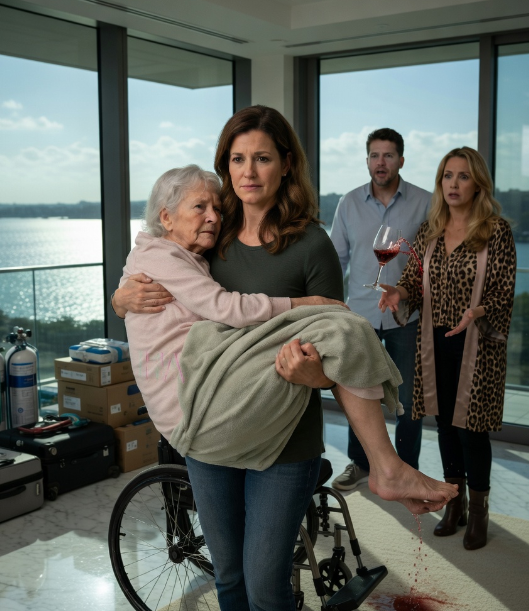
The color didn’t just leave his face; it seemed to evaporate. He looked at me, then at the wheelchair, then at the woman standing behind him—a twenty-something blonde in a silk robe, holding a glass of chilled Chardonnay.
“Elena?” Julian choked out. “What… what are you doing here?”
Eleanor, seeing her son, let out a soft, garbled cry of joy. “Julian! My boy!”
The mistress—Sienna, I presumed—let her glass slip. It didn’t shatter on the thick rug, but the wine soaked into the cream-colored wool like a bloodstain.
I didn’t wait for an invitation. I rolled Eleanor into the center of the pristine, minimalist living room. I set the brakes on her wheelchair with a sharp click.
I began unloading the bags.
“This is her evening dosage,” I said, placing a bottle of pills on the marble kitchen island. “She needs it with food, or she’ll get nauseous. Here are the instructions for the hoyer lift—you’ll need to order one by tomorrow morning, or your back is really going to feel it. These are the pads for the bed, and this is the cream for the rash she gets on her left hip.”
Julian stepped forward, his hands shaking. “Elena, stop. You can’t do this. We haven’t even talked about—”
“There’s nothing to talk about, Julian,” I said, straightening my back. I felt taller than I had in a decade. I looked at the mistress, whose eyes were wide with a growing, frantic realization of what “loving” Julian actually entailed.
I walked toward the door, stopping only to adjust Eleanor’s blanket one last time. She was looking around the room, her confusion finally beginning to override her joy. She saw the blonde woman. She saw the single bedroom through the open door. She saw the lack of medical equipment.
I turned back to the two of them. They were frozen—a tableau of a fantasy that had just been hit by a wrecking ball of reality.
“You told her I was the ‘breath of fresh air’ she needed, Julian,” I said, my voice echoing in the expensive silence. “And you,” I looked at the mistress, “wanted my place in his life so badly.”
I gripped the door handle, a smile tugging at the corners of my mouth.
“Congratulations. You finally got the promotion. Now take the part of his life you forgot to put in the brochure.“
I walked out. I didn’t take the elevator; I took the stairs. I needed to feel my legs moving, unfettered and strong. By the time I reached the street, the humid air of Savannah felt like the cleanest thing I had ever breathed.
Julian had moved in with his mistress to escape the “morgue” of his responsibilities. But as I started the car and drove toward the coast, I knew that for the first time in seven years, I wasn’t the one who was buried.