
PART 3
The investigation lasted six months.
The truth took twenty-three years.
The bicycles at Maple Ridge were not simply defective.
They were ghosts.
Not literally the same bicycles from Ray’s daughter’s time, but products built from the same rejected manufacturing lots, components, and fraudulent certification chain that should have disappeared decades earlier.
The state investigation eventually uncovered how.
After Emily died, Northstar Sporting Imports faced internal testing that showed a batch of children’s frames had been improperly welded.
The heat treatment had weakened the joints.
Company engineers recommended destroying the entire inventory.
Harold Vance refused.
Records later showed nearly six thousand frames were marked as scrap.
Only about four thousand were actually destroyed.
The rest vanished into overseas liquidation channels.
Years later, some returned to the United States as unbranded warehouse stock.
Different paint.
Different decals.
Different model names.
The underlying frames remained traceable through manufacturing stamps hidden inside the bottom bracket.
The bikes donated to Maple Ridge had been assembled using those old frames.
Twenty-three-year-old metal.
Repainted.
Recertified.
Sold as newly manufactured youth bicycles.
It was not an accident.
It was fraud.
But the cruelest part involved the foundation.
After Emily’s death, Caroline Vance Mercer—Ray’s former wife—had spent years publicly campaigning for bicycle safety.
She created the Mercer-Vance Children’s Foundation in Emily’s memory.
Photos of Emily appeared on fundraising brochures.
The foundation raised hundreds of thousands of dollars.
It donated helmets.
Sponsored safety courses.
Funded bicycle giveaways.
Caroline became a respected advocate.
What Ray never knew was that part of the foundation’s money was being used to purchase deeply discounted bicycles through companies connected to her father’s old distribution network.
Not because Caroline wanted children hurt.
The truth was more ordinary.
And in some ways worse.
She wanted the foundation to survive.
Cheap bicycles meant more giveaways.
More giveaways meant better photographs.
Better photographs meant more donors.
When a purchasing manager warned that Northstar Youth Mobility had incomplete manufacturing records, Caroline approved the deal anyway.
The email was eventually recovered.
We cannot afford premium suppliers if we intend to reach 1,000 children this year. These bikes meet the paperwork requirements. Proceed.
Paperwork requirements.
That sentence appeared in nearly every news story afterward.
Because the paperwork was fake.
The laboratory reports were copied from different models.
Serial numbers had been reused.
Inspection certificates were signed by a quality-control company that existed only as a mailbox in Nevada.
Redstone Recreation Supply had not manufactured the bikes.
But its executives had received warnings.
Twice.
One warehouse employee reported cracked welds.
A second reported duplicate serial numbers.
Management shipped the bicycles anyway.
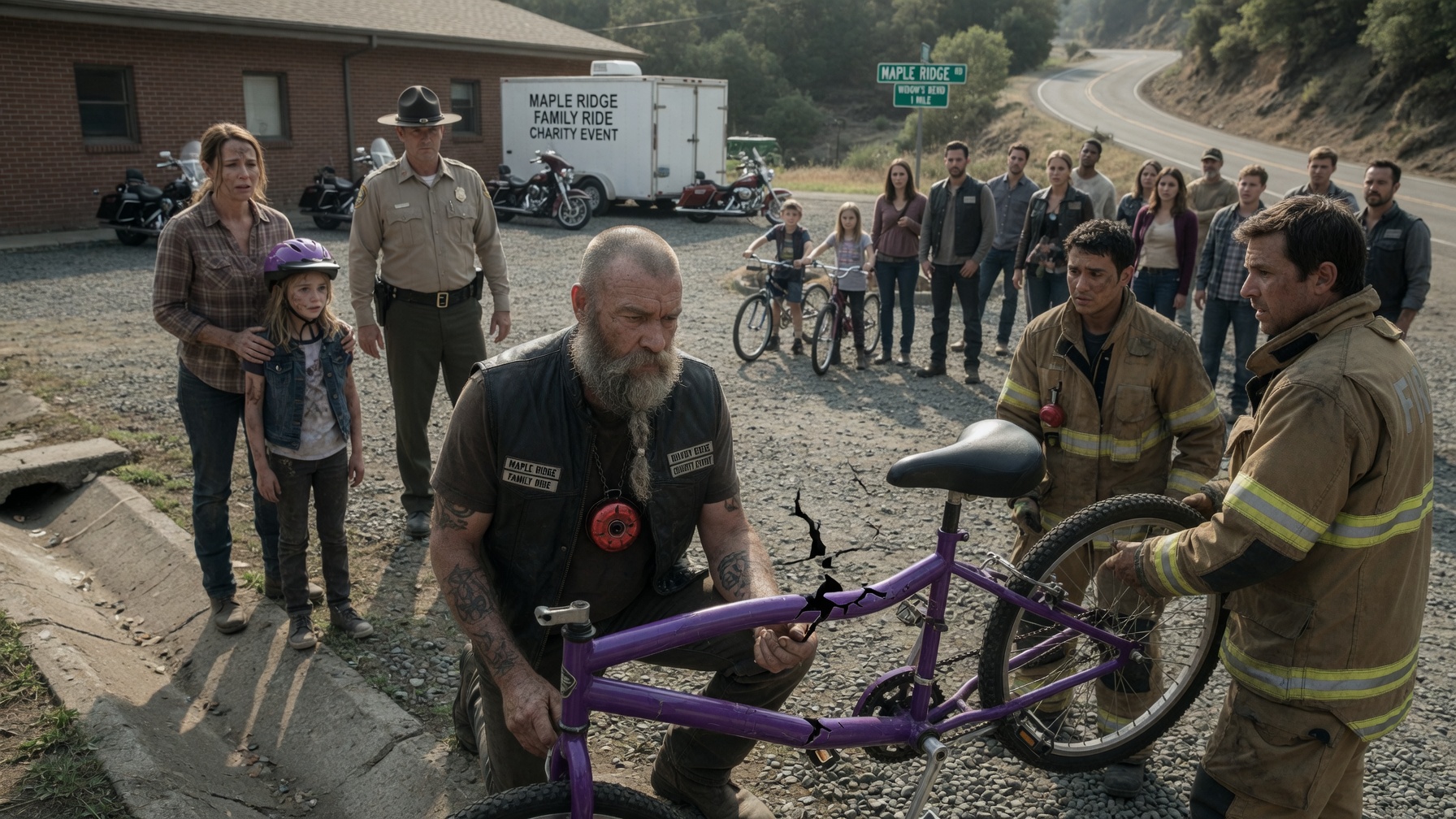
Then Ray found Sophie’s.
One thin line beneath a rocket-shaped sticker changed everything.
I learned why Ray noticed it when nobody else did.
He had spent twenty-three years studying bicycle frame failures.
Not professionally.
Obsessively.
After Emily died, he left diesel work and trained as a certified welding inspector.
He studied metallurgy at night.
He learned how cracks propagated.
How paint could conceal fatigue.
How bad weld penetration looked beneath magnification.
He testified in product-liability cases.
He inspected motorcycles after crashes.
And every spring, he volunteered with bicycle charities.
“He checks every weld,” Frank told me.
“Always?”
“Every single one.”
“Then why didn’t he inspect these before the event?”
Frank looked toward Ray.
“He wasn’t supposed to be here.”
Ray had left Riders for River County three years earlier after an argument with Travis.
Ray wanted every donated bicycle professionally inspected.
Travis said the cost would reduce the number of children they could help.
Neither was entirely wrong.
But they stopped speaking.
That morning, Ray had been riding past Maple Ridge when he saw the club trailer.
He stopped only to say hello.
Then he saw Sophie’s bicycle.
The purple frame reminded him of a manufacturing geometry he had seen before.
Not enough to prove anything.
Then Sophie turned the handlebars.
Sunlight hit the weld.
Ray saw the line.
He had perhaps ten seconds before she crossed the starting line.
So he did the fastest thing he could think of.
He took the bicycle away.
Parents shouted.
Sophie screamed.
He needed to know whether the line was paint damage or structural failure.
He could have explained.
He didn’t.
That was Ray’s flaw.
He had spent so many years expecting people not to believe him that he stopped trying to be believed.
He threw the bicycle into the ditch because he wanted to load the frame hard enough to expose the crack immediately.
It was reckless.
It damaged property.
It terrified my daughter.
But Dr. Shah later told me something I will never forget.
“If Sophie had entered Widow’s Bend on that bicycle, there is a high probability the frame would have separated.”
“How high?”
She shook her head.
“High enough that I wouldn’t let my child ride it across a parking lot.”
Sophie never heard that part.
I didn’t need her imagining the rest.
The criminal cases were complicated.
Harold Vance had died nine years earlier.
He could not answer for what happened to Emily.
But former Northstar executives were questioned.
Redstone executives faced fraud-related charges.
Several civil suits followed.
The foundation dissolved.
Caroline resigned before its board could remove her.
She was never accused of deliberately trying to injure children.
What she had done was ignore warnings because acknowledging them would damage the foundation she had built around her daughter’s death.
That distinction mattered legally.
It mattered less to Ray.
He saw Caroline only once after the investigation began.
I happened to be there.
The meeting took place outside the county administration building.
Caroline was elegant.
Silver hair.
Cream-colored coat.
The kind of person I would have imagined leading a charity luncheon.
She stopped when she saw Ray.
He had the cracked red bell in his hand.
For a long moment, neither spoke.
Then Caroline said:
“You made them destroy everything.”
Ray looked at her.
“They were dangerous.”
“We could have replaced them quietly.”
“That’s what your father said.”
Her face changed.
“You don’t know what my father said.”
“I know what he did.”
“He lost a granddaughter too.”
Ray stepped closer.
“And then he protected the company that killed her.”
Caroline’s eyes filled with tears.
“My father spent the rest of his life regretting it.”
“Regret is cheap when nobody has to know.”
“You think I don’t live with Emily every day?”
Ray looked down at the bell.
“I know you do.”
“Then why are you doing this to me?”
I expected him to yell.
He didn’t.
He looked exhausted.
“Because there were forty-seven more children.”
Caroline said nothing.
Ray continued.
“You saw a foundation.”
“You saw donors.”
“You saw budgets.”
“I saw forty-seven children standing at the top of that hill.”
He closed his fist around the bell.
“And for once, somebody stopped the ride before a parent had to identify a body.”
Caroline began crying.
Ray did not comfort her.
But he didn’t attack her either.
He simply walked away.
Riders for River County almost collapsed after the scandal.
Donations disappeared.
Sponsors withdrew.
Parents no longer trusted the program.
Travis blamed himself.
“I signed the purchase order.”
“You didn’t know,” I told him.
“I should have.”
“That sounds like something Ray would say.”
He laughed weakly.
“That’s why he drives me crazy.”
The club changed its entire process.
No more bicycles were distributed based solely on supplier paperwork.
Every frame received a physical inspection.
High-risk batches received nondestructive testing.
Serial numbers were verified independently.
It cost more.
They gave away fewer bicycles.
Ray approved.
“Forty safe bikes beat a hundred questionable ones.”
The following spring, the Maple Ridge Family Ride returned.
Smaller.
No speeches from sponsors.
No giant banners.
No promises about record numbers of bicycles distributed.
Just families.
Helmets.
Volunteers.
And forty-two carefully inspected bikes.
Sophie was first in line.
She was eleven now.
She had grown nearly three inches.
Her new bicycle was blue.
Not purple.
Ray rebuilt it himself from a steel frame manufactured in Wisconsin.
He gave me a folder containing every receipt, specification sheet, component number, and inspection record.
I laughed.
“You realize normal people just give someone a bike.”
“I’m working on normal.”
Sophie walked around it.
Then looked at him suspiciously.
“You’re not going to throw this one anywhere?”
“No.”
“Promise?”
Ray considered it.
“If I see a crack, I’m throwing it into the sun.”
She laughed.
It was the first time I heard her joke about what happened.
Then she noticed the bell.
A new red bell on her handlebars.
She touched it.
Ray froze.
Sophie looked at the broken bell still hanging around his neck.
“Is this because of Emily?”
He nodded.
Sophie rang it once.
A clean metallic sound.
Ray looked away.
I pretended not to see him wipe his eyes.
Before the ride began, Travis asked Ray to speak.
Ray refused.
Naturally.
So Travis spoke instead.
He stood in front of the families and said:
“Last year, one man made almost everyone here angry.”
People laughed.
Ray shook his head.
“He scared a child. He destroyed a bicycle. He ignored half the adults in the parking lot.”
More laughter.
“But he also asked the question the rest of us forgot to ask.”
Travis looked toward the children.
“Is it safe?”
The crowd became quiet.
“We wanted to keep a promise. Free bikes. A beautiful ride. Fifty smiling kids.”
He paused.
“But a promise that puts a child in danger is not worth keeping.”
Ray looked uncomfortable.
Good.
He deserved at least thirty seconds of public praise after twenty-three years of carrying that bell.
Then Travis said:
“Sometimes the person ruining the event is the only person paying attention.”
Sophie leaned toward me.
“He means Ray.”
“I gathered that.”
She smiled.
The children lined up.
Noah—Sophie’s friend from school—went first.
Sophie was second.
Ray stood beside the starting line.
He checked her helmet.
Both brakes.
Front axle.
Rear axle.
Handlebars.
Then, because he was Ray, he ran one finger across every visible weld.
Sophie sighed.
“Done yet?”
“No.”
“Ray.”
“One second.”
“You already checked it yesterday.”
“I slept since then.”
She rolled her eyes.
Finally, he stepped back.
“Okay.”
Sophie put one foot on the pedal.
Then stopped.
“Ray?”
“What?”
“Were you scared when Emily started down the hill?”
He went still.
Parents nearby pretended not to listen.
“Yes.”
“Are you scared now?”
Ray looked down Maple Ridge Road.
The sun was shining through the trees.
Volunteers were stationed at every turn.
The road had been swept.
Medical crews waited at the bottom.
Every bicycle had been checked.
Still, he nodded.
“Yes.”
Sophie thought about that.
Then she smiled.
“Good.”
Ray frowned.
“Good?”
“My mom says being scared sometimes means you understand what can go wrong.”
I had said that once.
I hadn’t expected her to remember.
Ray smiled.
“Your mom sounds annoying.”
“She is.”
“Hey.”
Sophie laughed.
Then she pushed off.
The red bell rang.
Once.
Twice.
Three times.
Ray watched her descend.
I watched Ray.
At the entrance to Widow’s Bend, Sophie disappeared behind the trees.
Ray stopped breathing.
I knew because I did too.
Five seconds.
Ten.
Then the radio clipped to Travis’s vest crackled.
A volunteer at the bottom spoke.
“Rider two clear.”
Ray closed his eyes.
Just for a second.
When he opened them, Sophie was already ringing that ridiculous bell somewhere farther down the hill.
Ray touched Emily’s broken one.
Twenty-three years earlier, he had failed to stop one bicycle.
For most of his life, he believed that failure defined him.
But standing beside that starting line, I finally understood something he had never allowed himself to believe.
He had not thrown Sophie’s bicycle away.
He had thrown away his reputation.
The event.
His friendship with Travis.
Whatever strangers thought of him.
Anything he could sacrifice in those few seconds.
Because forty-seven children were waiting at the top of a hill.
And Ray Donovan had already learned the hardest lesson a father could learn.
Sometimes protecting a child does not look heroic.
Sometimes it looks rude.
Reckless.
Unreasonable.
Sometimes everybody in the parking lot hates you.
And sometimes you let them.
Because children can forgive a ruined morning.
They can forgive a canceled ride.
They can even forgive a bicycle thrown into a ditch.
What a parent cannot undo—
is the moment they realize somebody saw the danger,
said nothing,
and let the child ride anyway.