
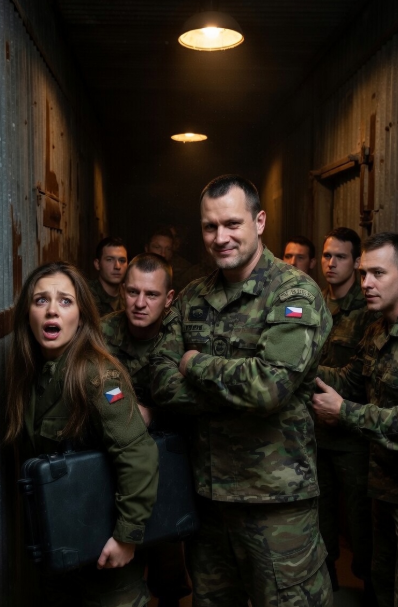
The high desert of Nevada does not forgive the unprepared. At Camp Resolute, a jagged outcrop of black rock and corrugated steel situated eighty miles from the nearest paved road, the wind carries a fine, alkaline dust that gets into everything—your lungs, your coffee, and, most dangerously, the delicate internal architecture of encrypted satellite relays.
Eliana Voss arrived on a Tuesday, stepping off a dusty transport helicopter with nothing but a Pelican hardshell case and a canvas rucksack. She was dressed in a charcoal-grey tactical work jacket and heavy trousers, her dark hair pulled back into a knot so tight it looked painful.
To the transient population of Tier-One operators, Rangers, and support staff, she was a non-entity. The manifest listed her as a “Category 4 Technical Specialist.” In the rigid caste system of a military outpost, she was a “Sitter”—someone who sat in a climate-controlled room and stared at blinking green lights while the “Doers” went out and bled in the sand.
“You the one here to fix the burst-comms?” the base adjutant asked, barely looking up from his screen as she checked in.
“Yes,” Eliana said. Her voice was low, devoid of inflection, and perfectly level.
“Maintenance Bay 3. Your quarters are in B-Block. It’s a shared hallway with the rotating SEAL element. Try to stay out of their way. They’re mid-cycle and cranky.”
Eliana took her key card. “I’m not here to be in anyone’s way.”
She spent the first forty-eight hours in the shadows of the comms-vault. She didn’t go to the gym. She didn’t linger in the mess hall. She ate MREs in her workspace, her fingers moving with surgical precision through nests of fiber-optic cables. She was a ghost in the circuits, a woman who seemed to occupy less space than the air she breathed.
The Predators
Mason Rourke and Tyler Quinn were not ghosts. Rourke was a Senior Chief with eighteen years of specialized warfare under a belt that looked like it was made of iron. He was wide, scarred, and possessed the loud, booming confidence of a man who had survived three separate helicopter crashes. Quinn was younger, a “Trident” wearer with a year of combat deployments and the restless, twitching energy of a predatory bird.
They were bored. Boredom at Camp Resolute was a corrosive substance. It led to “recreational friction”—the habit of testing anyone who didn’t look like they belonged in their world.
They first noticed Eliana on Thursday evening. She was walking back to B-Block, carrying a diagnostic tablet.
“Hey, Sparky,” Quinn called out, leaning against a reinforced concrete pillar. “You actually fix anything today, or just play Minesweeper on the government’s dime?”
Eliana didn’t break her stride. She didn’t even look at him. She simply adjusted the strap of her bag and kept walking.
Rourke chuckled, a deep, rattling sound in his chest. “Quiet one. I bet she’s got a personality like a dial-up modem.”
“I bet she’s just tucked away here because she couldn’t cut it in a real office,” Quinn added, loud enough for his voice to trail her down the hall. “Hey! Techie! I’m talking to you.”
Eliana reached her door, swiped her card, and vanished inside without a single word.
To men like Rourke and Quinn, silence wasn’t a boundary. It was a vacuum that demanded to be filled with their own dominance.
The Corridor
The incident occurred at 0445 on Friday. The base was in that liminal state between the night watch and the morning stand-to. The lighting in the service corridor leading to the signal wing was dimmed to a dull, amber haze.
Eliana was heading to the vault early. The encrypted relay on the northern perimeter had desynced at midnight, and she had a four-hour window to re-code the handshaking protocol before the morning sorties. She was carrying a heavy component case—forty pounds of lead-shielded electronics.
She heard them before she saw them. The heavy, rhythmic thud of boots on concrete.
Rourke stepped out from a cross-corridor twenty feet ahead. He didn’t look like he was going anywhere. He was just… there. Standing in the center of the narrow passage, his arms folded across a chest that was the size of a beer keg.
Eliana stopped. She didn’t look afraid. She didn’t look annoyed. She looked like she was calculating a mathematical equation.
“Maintenance is closed this early, isn’t it?” Rourke asked. His voice was a low rumble, echoing off the corrugated walls.
Eliana didn’t answer. She attempted to side-step him, moving toward the right wall. Rourke shifted with her, his massive frame blocking the path.
“I asked you a question, Sparky.”
From behind her, the sound of a second pair of boots signaled Quinn’s arrival. He had moved up silently, boxing her in. The air in the corridor grew thick with the smell of stale coffee and the aggressive, unearned swagger of two men who thought they were playing a game.
“You know,” Quinn said, his voice inches from her ear. “It’s rude to ignore the guys who keep this base safe while you’re in here playing with wires.”
“I have work to do,” Eliana said. Her voice remained flat, but there was a new edge to it—the sound of a blade being unsheathed in a dark room. “Move out of my way.”
Rourke grinned. It wasn’t a friendly expression. He reached out, his hand moving toward the heavy case she was holding. “Maybe I want to see what’s in the box. High-level tech? Sensitive? Maybe I should inspect it.”
“Touch that case,” Eliana said, her eyes finally locking onto Rourke’s, “and you’ll wake up on the floor.”
The silence that followed was absolute. Then, Quinn burst into a jagged, mocking laugh.
“Did you hear that, Senior? The IT girl thinks she’s a hitter. Honey, you wouldn’t know which end of a rifle to—”
Quinn reached out, his hand moving to grab Eliana’s shoulder, intending to spin her around and “put her in her place.”
It was the last conscious decision he would make for a while.
The Physics of Violence
In the world of high-tier special operations, there is a concept called Economy of Motion. It is the art of achieving the maximum kinetic result with the minimum physical expenditure.
Eliana Voss didn’t “fight” them. She dismantled the physics of their positions.
As Quinn’s hand closed on her shoulder, Eliana didn’t pull away. She moved into the grab. She dropped her center of gravity, her left hand snapping upward like a piston, catching Quinn’s elbow and driving it upward. Simultaneously, she stepped through his stance.
It was a textbook centrifugal throw, amplified by Quinn’s own forward momentum.
His feet left the ground. He didn’t even have time to grunt before his back slammed into the concrete floor with a sound like a wet sack of flour hitting a sidewalk. The air left his lungs in a violent rush, and his head bounced once, hard, against the deck. His eyes rolled back. Out.
Rourke’s reaction was instinctive. He was a veteran; he didn’t freeze. He launched a heavy, haymaker right cross designed to take her head off.
Eliana didn’t block it. You don’t block a man who weighs 240 pounds. You redirect him.
She ducked under the swing, her body a blur of charcoal-grey fabric. She caught Rourke’s extended arm with both hands, twisting her hips and using his own weight as a lever. She drove her palm into the base of his ribs—a sharp, concentrated strike that disrupted the diaphragm—and then swept his leading leg.
Rourke hit the wall first, his shoulder absorbing the impact with a sickening crack, before he slid down the corrugated metal to the floor, gasping for breath, his face turning a dark shade of purple as his lungs refused to expand.
The entire engagement had lasted 4.2 seconds.
Eliana Voss picked up her component case, which she had set down so gently it hadn’t made a sound. She looked down at Rourke, who was clutching his ribs, his eyes wide with a mixture of agony and pure, unadulterated shock.
“I told you,” she said. Her voice hadn’t risen a single decibel. It was still the same low, level hum.
She stepped over Quinn’s limp form and continued down the hallway toward the comms-vault.
The Manifest
Ten minutes later, the morning shift of the Shore Patrol found them. Quinn was still semi-conscious, mumbling about “a shadow,” and Rourke was sitting against the wall with two broken ribs and a dislocated shoulder.
When the Base Commander, Colonel Halloway, arrived at the infirmary, he was furious. “You’re telling me two of the most highly trained operators in the U.S. Navy were hospitalized by a civilian contractor? A technician?”
“She… she wasn’t human, sir,” Rourke wheezed, his face pale. “She moved before I even thought about swinging.”
Halloway didn’t believe it. He stormed into the administrative office and pulled Eliana Voss’s personnel file. Not the “Service” file—the Deep file. The one that required a biometric override and a call to a classified number at Fort Meade.
As the file unspooled on his screen, the color drained from Halloway’s face.
Eliana Voss was not an IT specialist.
She was a former Tier-Zero operative from a unit so redacted it didn’t even have an acronym. Her training history included three years at the “Farm,” a specialized stint with the Israeli Mossad’s Kidon unit, and a documented history of “Close Quarters Elimination” that made a SEAL’s training look like a summer camp.
She had retired after a “black” op in the Hindu Kush went sideways, leaving her as the sole survivor. She had taken the tech specialist job because she wanted to be around systems that made sense, away from the noise of men who thought violence was a personality trait.
Halloway looked at the final line of her psychological profile: Subject possesses an extreme aversion to unnecessary conflict, but maintains a ‘Response-to-Threat’ ratio of 1:10. Recommendation: Do not disturb.
The Aftermath
Eliana sat in the comms-vault, her diagnostic tablet plugged into the northern relay. The screen was scrolling through thousands of lines of code.
The door opened. It was Colonel Halloway. He was alone.
He stood there for a moment, looking at the quiet woman who was currently re-coding a billion-dollar encryption suite. She looked so small, so unassuming.
“Voss,” Halloway said.
“Colonel.” She didn’t turn around.
“Senior Chief Rourke is in surgery. Quinn has a grade-three concussion. They’ve both been processed for disciplinary action under Article 134.”
Eliana’s fingers didn’t stop moving across the keys. “That’s your prerogative, Colonel.”
“I looked at your file,” Halloway said, his voice dropping. “The real one. I apologize. I should have briefed my men on… who was on base.”
“No,” Eliana said. She finally turned her chair around. Her eyes were as calm and deep as a mountain lake. “You shouldn’t have had to. Your men shouldn’t need a file to know how to treat a human being with respect. If they need to know I’m a ‘killer’ before they decide to let me walk down a hallway, then they aren’t the operators you think they are.”
Halloway winced. It was a fair strike.
“Is there going to be a problem, Voss? Are you going to quit?”
Eliana looked back at her screen. The green lights were blinking in perfect synchronization. “The northern relay is fixed. I have three more modules to desync. I’ll be finished by Wednesday.”
“And then?”
“And then,” Eliana said, “I’ll get on the helicopter, and I’ll go back to being a ghost. Just make sure the next two you send to ‘test’ me are better at it.”
She went back to her code. Halloway watched her for a moment longer, realized there was absolutely nothing he could say that would carry more weight than her silence, and walked out.
For the rest of her time at Camp Resolute, Eliana Voss was never bothered again. The operators gave her a wide berth, whispering about the “Ghost in the Wire.” But Eliana didn’t care about the whispers. She only cared about the systems.
Because in a world full of men who mistook volume for power, Eliana Voss knew the truth: The most dangerous thing in the room is the one that doesn’t need to make a sound.